
How to Change Careers Without Starting Over
The hardest job to land in a new field is the first one.
It wasn’t because I was unqualified. I had years of experience, a strong work ethic, and references who would vouch for me. What I didn’t have was any work history in my target field, any reference from inside it, or the insider familiarity that people raised in that career path take for granted.
My first application got no response. Neither did the next five. The tenth led to an interview, but they hired someone with direct experience. By my fifteenth application, I had an offer. It wasn’t the dream role. It was a bridge role that valued my transferable skills, and it started everything that came after. If you’re still working toward that first job in a new country, start with our guide on how new immigrants can get their first job.
This guide lays out what I wish I’d known: how hiring works for career changers, how to make your resume and LinkedIn profile speak your new industry’s language, which employers to target first, and how to run your search so it produces an offer sooner.
How Career-Change Hiring Actually Works
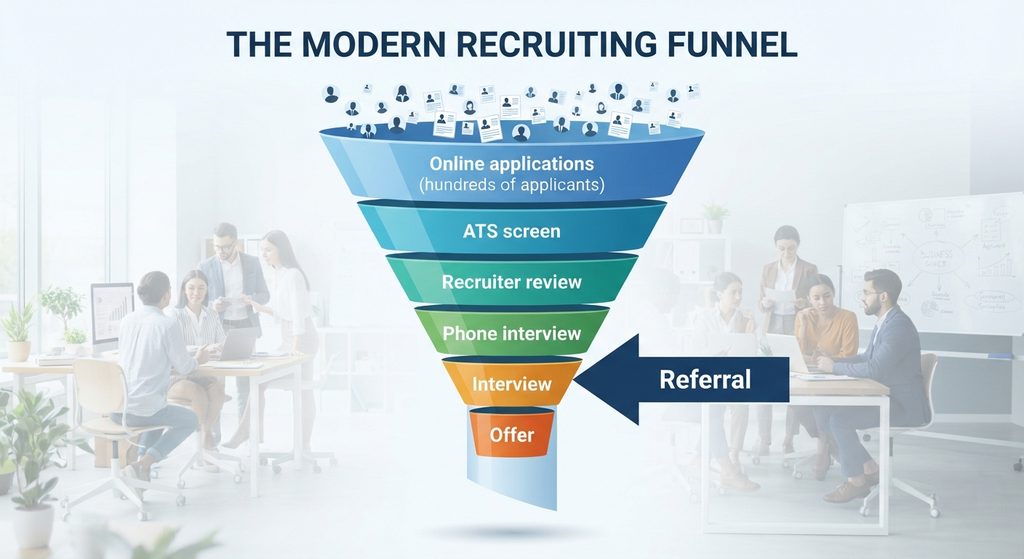
Most career changers apply online and wait. That path has the most competition and the lowest response rate.
Here is what happens behind the scenes:
- A job is posted and often draws hundreds of applications.
- An Applicant Tracking System (ATS) screens resumes for keywords. Resumes that still use your old industry’s terminology often get cut here.
- A recruiter reviews the resumes that passed.
- A shortlist gets phone interviews, then in-person or video interviews.
- An offer goes out.
At every stage, employers tend to treat a candidate without direct experience as the riskier hire. That’s not fair, but it’s real, so your strategy has to account for it.
The fix is to enter the funnel somewhere other than the top. A referral skips the ATS and the recruiter screen entirely and puts your resume in front of the hiring manager with someone’s endorsement attached. That’s why networking matters so much for career changers.
Step 1: Rebuild Your Resume for the New Industry
A resume built for your old career is probably wrong for your new one. Rebuild it before you apply anywhere.
- Length: One page if you have under ten years of experience, two at most for senior professionals.
- Format: Use a hybrid layout. Lead with your most relevant projects and transferable skills, then add a clean reverse-chronological work history. Leave off photos, birth dates, and ID numbers.
- Bullets: Give each role two to five accomplishment-focused bullets, not duty lists. “Responsible for managing client schedules” becomes “Managed high-volume client workflows, improving project delivery speed by 20%.” Use numbers that matter to your target industry.
- Keywords: Mirror the job description. If it says “stakeholder management” and your resume says “client communication,” an ATS may not connect them.
- Contact details: Include a professional email, phone number, city and state, and LinkedIn URL. Skip your street address.
Canva, Resume.io, and Google Docs all offer free templates, and many professional associations offer free resume reviews through industry mentors.
Before you apply, also make sure you understand what your status allows. Our comparison of green card vs. work visa vs. undocumented explains how each affects the jobs you can take.
Step 2: Optimize LinkedIn Before You Apply
Recruiters search LinkedIn, hiring managers check it, and many referrals start there. Finish your profile before you send your first application.
- Photo: A clear, well-lit professional headshot.
- Headline: Replace your old job title with a bridge statement, such as “Project Manager Transitioning to Tech Operations | Optimizing Cross-Functional Workflows.”
- Summary: Two to three first-person sentences covering your transition, your strongest transferable skills, and the roles you want.
- Experience: Keep the same companies and dates, but rewrite the bullets around skills your new field values.
- Skills: List 10 to 20 skills tied to your target role, since these feed recruiter searches.
- Open to Work: Turn it on, either publicly or for recruiters only.
- Connections: In week one, connect with people in your target industry, alumni who made similar pivots, and former colleagues. Add a short personal note explaining your transition.
Step 3: Target Employers Who Are Open to Career Changers
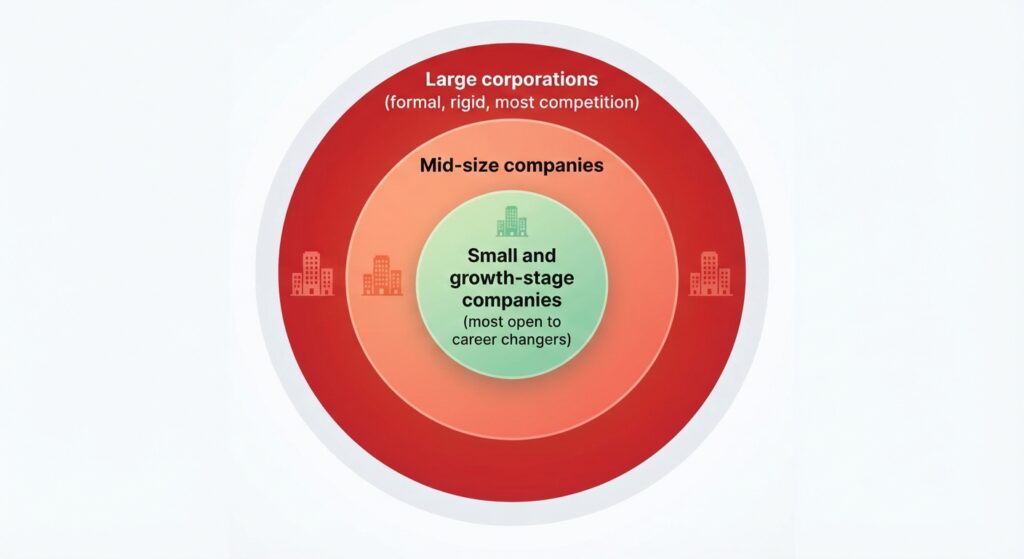
Bigger isn’t better here. Large companies have the most formal processes, the strictest credential requirements, and the most competition, so they’re also where a career changer is most likely to be screened out automatically.
Small and mid-size companies hire more informally. A department head often makes the call, and they care more about whether you can solve their problems than whether your old titles match a template. They’re also more responsive to referrals and direct conversations. Startups and scaling companies are often the most accessible of all, because growing teams value broad problem-solving over narrow industry pedigree.
Focus on smaller and mid-size employers first. Once you have experience in the new field on your resume, larger companies get much easier to approach.
Not sure which fields to aim for? Our breakdown of the best careers for new immigrants can help you narrow the list.
Step 4: Work Your Network
Widely cited estimates say a large share of jobs are filled through personal connections. Whatever the exact figure, referrals clearly outperform cold applications for career changers. Three places to start:
- Industry associations and local chapters: Many run job boards, mentorship programs, and events for people entering the field.
- Alumni networks: Your school or certification program’s alumni include hiring managers, recruiters, and people who’ve made the same move. Tell them you’re pivoting.
- Former colleagues who’ve already switched: Ask for a 30-minute informational interview about how they did it. These conversations reliably produce market insight, introductions, and referrals.
Step 5: Treat the Search Like a Process You Can Improve
A career-change search almost always takes longer than expected. A system keeps you from quitting early.
- Set a weekly target. Ten to fifteen targeted applications is a sustainable pace. Fewer drags the search out, and more usually means you’ve stopped customizing.
- Track everything. Use a simple spreadsheet with the company, role, date applied, and status, and watch for patterns in which roles produce interviews.
- Customize each application. Open your cover letter or message by naming the company and explaining how your background solves a problem they have.
- Follow up after two weeks. For example: “I applied for the [role] position on [date] and wanted to confirm you received my application. I remain very interested and would welcome the chance to speak.”
- Debrief every interview. Write down what was asked, what went well, and what you’d change. People who land their first role fastest treat each interview as practice for the next.
Job searches often take longer than expected, so build a cushion first. Our budget tracker and guide to creating your first budget can show you how many months you can afford to search.
Build Skills Without Spending Much
Focused upskilling is one of the best investments a career changer can make.
- Certifications and micro-credentials: Coursera, edX, Google Career Certificates, and LinkedIn Learning offer free or low-cost options that add credibility quickly.
- Public libraries: Many provide free computer access, printing, and career counseling or resume help through partner organizations.
- Mentorship programs: Nonprofit and community programs pair career changers with experienced professionals for guidance, portfolio reviews, and introductions.
- Portfolio projects: Free or low-cost bootcamps, workshops, and open-source work let you demonstrate skills directly, without waiting for formal credentials.
Take the Bridge Role
Landing your first role in a new industry takes patience, steady effort, and a willingness to accept a lateral move or a small step down in order to build relevant work history.
A bridge role can be anything from an entry-level position in your target field to a job that simply pays the bills while you keep searching. If you’re weighing options, see warehouse jobs vs. retail jobs: what pays more and delivery jobs explained. Some people also cover the gap with gig work and side hustles while they search.
Career changers who hold out for a senior title often wait much longer than those who take a foundational role, perform well, and get promoted within 12 to 18 months.
The first job in a new field is a door. It doesn’t have to be the room you stay in. It just has to open.
Once you land the role, check whether your employer offers a retirement plan with what is a 401(k) and should I actually use mine, and see how to get health insurance as an immigrant if it doesn’t come with the job. For more ways to grow your income, browse our Earn More section.
Disclaimer: This article is for educational purposes only and isn’t legal, financial, or career advice. Job market conditions and program availability vary by location and change over time. Verify current details directly and consult a professional about your situation.