
Highest-Paying Jobs Without a Degree in North America
One of the most persistent myths that follows immigrants through their first years in North America is this: that a university degree from your home country that is not recognized here means you are starting over from nothing.
It does not.
Some of the highest-paying, fastest-growing jobs in the United States and Canada require no four year college degree at all. They require a license, an apprenticeship, a certification, or in some cases nothing more than on the job training. Many of them are in chronic shortage, which means employers are actively competing for workers. And many of them are in industries where immigrants already have strong representation and where physical skill, reliability, and the willingness to do demanding work are valued above where you went to school.
This article gives you the full picture: the actual jobs, the actual salaries, and what it takes to get into each one. Two lists, one for the United States and one for Canada, with everything designed for sharing, saving, and acting on.
United States: Highest-Paying Jobs Without a 4-Year Degree
All salary data from the US Bureau of Labor Statistics Occupational Employment and Wage Statistics, May 2024 (released 2025, reviewed for 2026).
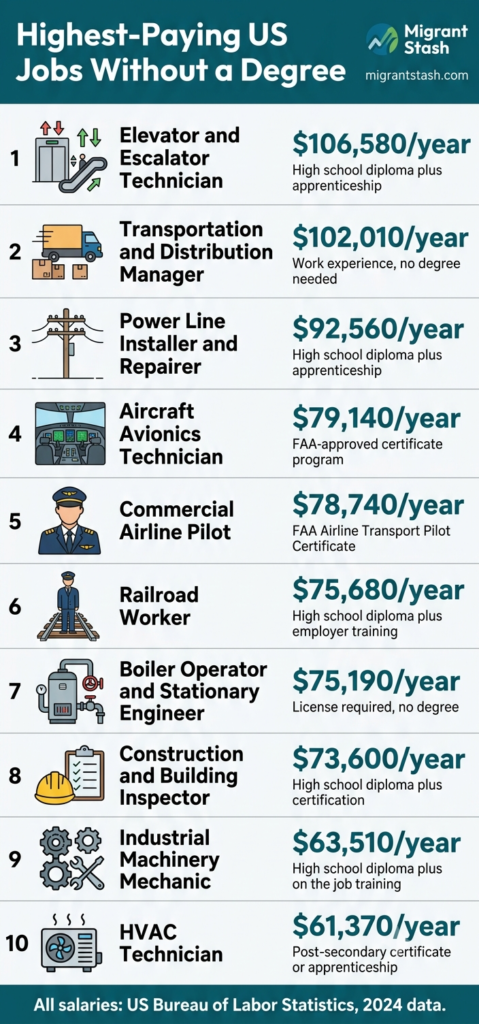
Breaking Down the Top US Options for Immigrants
Elevator and Escalator Technician This is consistently the highest-paying trade job in America that requires no college degree. Technicians install, maintain, and repair elevators, escalators, and moving walkways. Entry is typically through a four year apprenticeship with the International Union of Elevator Constructors (IUEC), which pays you while you train. Top earners in high-cost cities like New York, San Francisco, and Chicago regularly exceed $150,000 per year with overtime.
Power Line Installer and Repairer Electrical power line workers install and maintain the systems that deliver electricity to homes and businesses. Entry requires a high school diploma and completion of an apprenticeship program through a utility company or union. The Bureau of Labor Statistics projects 7% job growth over the next decade, one of the stronger outlooks in the trades. Physical demands are significant and the work involves heights and outdoor conditions.
Commercial Airline Pilot Entry does not require a four year degree. It requires an FAA Airline Transport Pilot Certificate, which is obtained through flight training programs that can be completed at community colleges, aviation academies, and military training. The time and financial investment in licensing is substantial, but regional airline starting salaries now regularly begin at $60,000 to $80,000 and major airline captains earn well above $200,000. Demand for commercial pilots in North America remains strong.
HVAC Technician Heating, ventilation, and air conditioning technicians are in consistent high demand in virtually every region of the United States. Entry requires completing a post secondary certificate program, typically six months to two years, or an apprenticeship. Licensing requirements vary by state. In warm-weather states like Texas, Florida, and Arizona, experienced HVAC technicians regularly earn $70,000 to $90,000 or more with overtime.
Construction and Building Inspector Inspectors examine buildings and construction sites to ensure compliance with safety codes and regulations. Entry requirements vary by jurisdiction but typically include a high school diploma, relevant work experience in construction, and a state or local certification. This is an accessible career transition for immigrants who already have construction or contracting experience from their home country.
Canada: Highest-Paying Jobs Without a University Degree
Salary data from the Government of Canada Job Bank and Statistics Canada, 2025 to 2026.
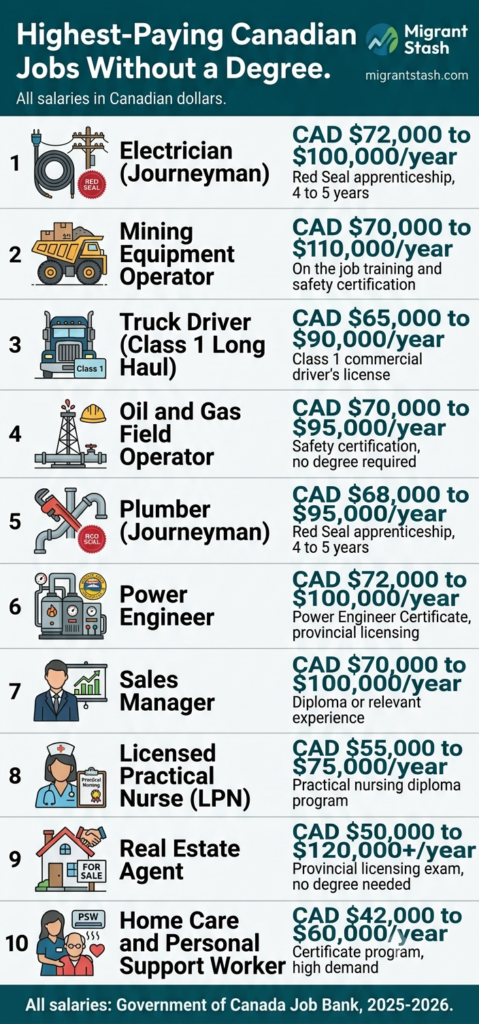
Breaking Down the Top Canadian Options for Immigrants
Electrician (Journeyman) Canada faces a significant shortage of licensed electricians, and the Red Seal apprenticeship program is the entry path. Apprenticeships run four to five years and pay you while you train, starting at roughly 40 to 50% of journeyman wages and increasing each year. A Red Seal designation allows you to work in any province without additional testing, which is particularly valuable for immigrants who may move between provinces. Demand is projected to remain high for at least the next decade due to infrastructure projects and the energy transition.
Mining Equipment Operator Northern Ontario, Saskatchewan, British Columbia, and the Northwest Territories all have active mining operations with ongoing labor needs. Entry typically requires only on the job training and safety certifications, which employers often provide. Remote work schedules, typically two weeks on and two weeks off, allow for significant accumulation of hours and overtime pay. Some mining roles regularly produce total compensation above CAD $100,000.
Oil and Gas Field Operator Alberta remains the center of Canadian oil and gas employment, with Fort McMurray and the surrounding region offering some of the highest wages available to workers without a degree anywhere in the country. Entry requires safety certifications and employer training. The work is physically demanding and often in remote locations, but the financial returns are among the most accessible anywhere in the labor market for newcomers willing to relocate.
Licensed Practical Nurse (LPN) LPN diploma programs in Canada typically run 12 to 24 months and are offered at community colleges across the country. For immigrants who have healthcare experience or nursing training from their home country, provincial credential recognition pathways exist in most provinces, though the process varies significantly by province and country of origin. Demand for LPNs in Canada is high and growing, particularly in long-term care, home care, and rural health settings. Immigration pathways specifically designed for healthcare workers exist at both the federal and provincial levels.
Real Estate Agent Provincial licensing exams in Canada do not require a university degree. In Ontario, the process involves completing required courses through OREA (Ontario Real Estate Association) and passing the licensing exam. In British Columbia, the process runs through UBC Sauder. In Alberta, through RECA. Income is commission based and highly variable, but successful agents in active markets like Toronto, Vancouver, and Calgary regularly earn well above CAD $100,000. This is one of the clearest paths to high income for immigrants who develop strong local market knowledge and a community based referral network.
What Both Lists Have in Common
Looking across both the US and Canadian lists, several patterns repeat that are worth naming clearly.
Trades dominate. Electricians, plumbers, HVAC technicians, and power line workers appear on both lists and represent the most consistent path to high income without a degree. Trade apprenticeships pay you while you train, typically starting between $18 and $28 per hour and increasing through four to five years of structured on-the-job learning. The credential you earn, whether a Red Seal in Canada or a journeyman license in the US, is portable across the country and recognized everywhere.
Physical and outdoor work pays a premium. Mining, power line installation, oil and gas operations, and similar roles carry physical risk and demand exposure to difficult conditions. The labor market compensates for this. If you are physically capable and willing, these roles offer among the most rapid income growth available anywhere in the unskilled to skilled worker pipeline.
Healthcare without a degree is real and growing. LPNs in Canada and CNAs, medical assistants, and home health aides in the US represent a growing category of healthcare roles that require certification programs rather than degrees. Aging populations in both countries mean demand for these roles will continue to increase for decades. For immigrants with any healthcare background from their home country, this category deserves specific attention.
Sales and management roles are accessible on merit. Sales manager, distribution manager, and real estate roles on both lists do not typically require degrees. They require results. Immigrants who develop strong English communication skills, local market knowledge, and a reliable referral network can advance into these roles faster than the institutional paths of most degree required careers allow.
The Financial Picture: What These Jobs Can Do for You
An HVAC technician in Houston or Phoenix earning $75,000 per year is in a position to invest, to buy a home, and to build the kind of financial foundation that changes their family’s trajectory. A truck driver in Alberta earning CAD $85,000 per year is in a similar position.
These are not consolation prizes for people who could not get degrees. They are skilled professions with real demand, real income, and real futures. In many of them, an experienced worker with their own business earns more than most lawyers and professors.
The financial tools available to you once you are earning at these levels are the same tools we write about throughout this blog: building credit from zero, investing in index funds, opening a Roth IRA, buying a home, and sending money home without losing it to fees. The income unlocks the tools. The tools build the wealth.
How to Get Started: The Practical First Steps
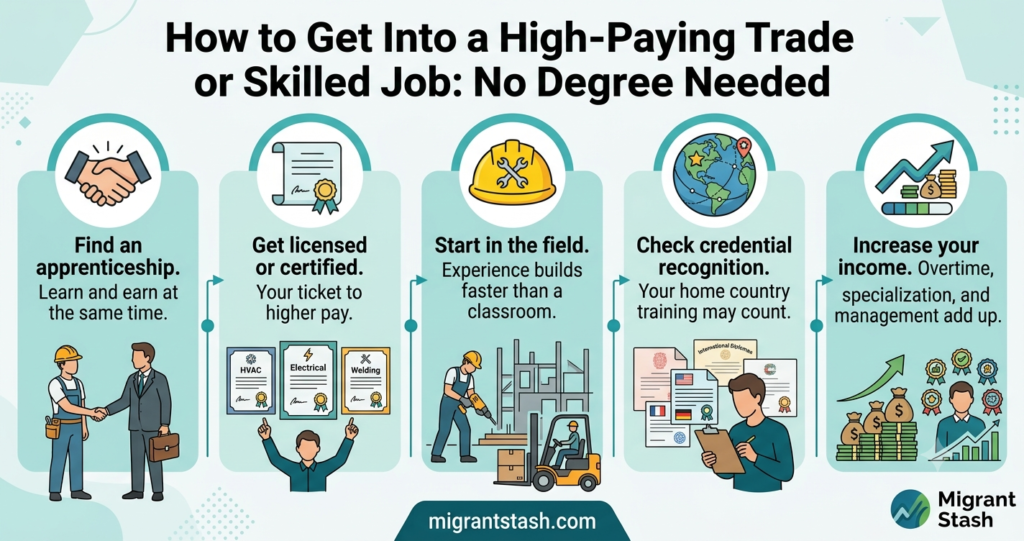
If any role on these lists interests you, here is the universal starting point regardless of which country you are in and which job you are considering.
Step 1: Research the licensing or certification body for that specific trade in your specific state or province. Every trade has a governing body that sets training requirements and issues licenses.
Step 2: Find out whether your experience from your home country qualifies for any exemptions or accelerated pathways. Many trades have credential recognition agreements, and your prior experience may reduce the time and cost of getting licensed.
Step 3: Contact local union halls, community colleges, and employer associations about apprenticeship openings. Union apprenticeships in both the US and Canada are particularly valuable because they pay competitive wages during training and provide benefits.
Step 4: Get your financial foundation in order while you pursue licensing. An emergency fund, a free bank account, and the beginning of a credit history are all things you can build simultaneously with your skills training. The income upgrade you are working toward will have more impact when the financial tools are already in place to capture it.
Disclaimer: Salary figures reflect median wages from the US Bureau of Labor Statistics and the Government of Canada Job Bank and are subject to regional variation and change. Licensing and training requirements vary by state, province, and employer. Always verify current requirements with the relevant licensing body in your jurisdiction.