
She Retired at 58 With Nothing When She Arrived in the US
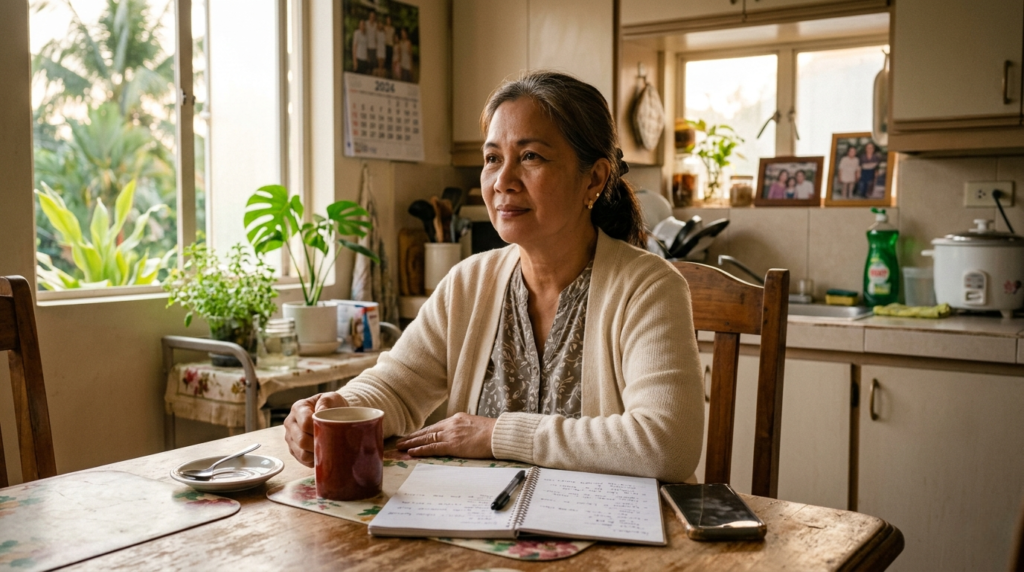
Her name is Marisol. She is a registered nurse from Cebu City in the Philippines who has lived and worked in the United States for twenty-two years. She worked nights for most of that time — first in a long-term care facility in New Jersey, then in a surgical step-down unit in Houston, where she has lived for the last fourteen years. She sent money home to her parents and two younger siblings every month for the first decade. She paid for her sister’s nursing degree. She paid for her brother’s vocational training. She helped her parents build a concrete house on land that had been in the family for forty years.
She retired at fifty-eight with no debt, a paid-off home in Pearland, a rental property that generates income, and a retirement account that her financial planner describes as genuinely comfortable.
She did not inherit money. She did not marry into money. She did not win anything or discover anything or stumble into anything. She worked nights, lived carefully, and made a series of deliberate financial decisions over two decades — some of them obvious in retrospect, some of them counterintuitive, and a few of them so specific to the immigrant experience that you will not find them in any mainstream personal finance book.
She gave me permission to tell this story using her first name. She wants it told, she said, because she spent years believing that retirement was something that happened to other people — people with higher salaries, people born here, people without remittance obligations or immigration lawyers to pay or family abroad who depended on them. She does not want anyone else to spend years inside that belief if they do not have to.
This is her story. And it is also, as precisely as I can make it, a replicable framework.
How She Arrived
Marisol came to the United States in 2002 on a work visa sponsored by a nursing staffing agency in New Jersey. She was thirty-six years old. She had a suitcase, a money belt with $400 in it, and a list of phone numbers written in her mother’s handwriting on a folded piece of paper.
She owed the agency $8,000 in placement fees. She would repay them through deductions from her first eighteen months of paychecks. She did not fully understand this arrangement when she signed it. She understood it by the end of her first pay period.
“I made $19 an hour,” she told me. “After the deduction and taxes and the room they arranged for me, I had maybe $200 left. And I sent half of that home.”
She was not unusual in this. The early financial situation of immigrant nurses in the United States is often invisible to the mainstream conversation about healthcare worker salaries. The salary is real. The obligations surrounding it — agency fees, shared housing, remittance commitments, the constant cost of maintaining legal status — are also real. What remains after both is frequently far less than it appears from the outside.
She did not start building wealth in those first eighteen months. She started learning.
The First Five Years: Survival and Foundation
The financial architecture Marisol eventually built rested on decisions she made in the first five years, several of which she made without fully understanding why they were right — she made them because they felt like the only options available, and they turned out to be the correct ones.
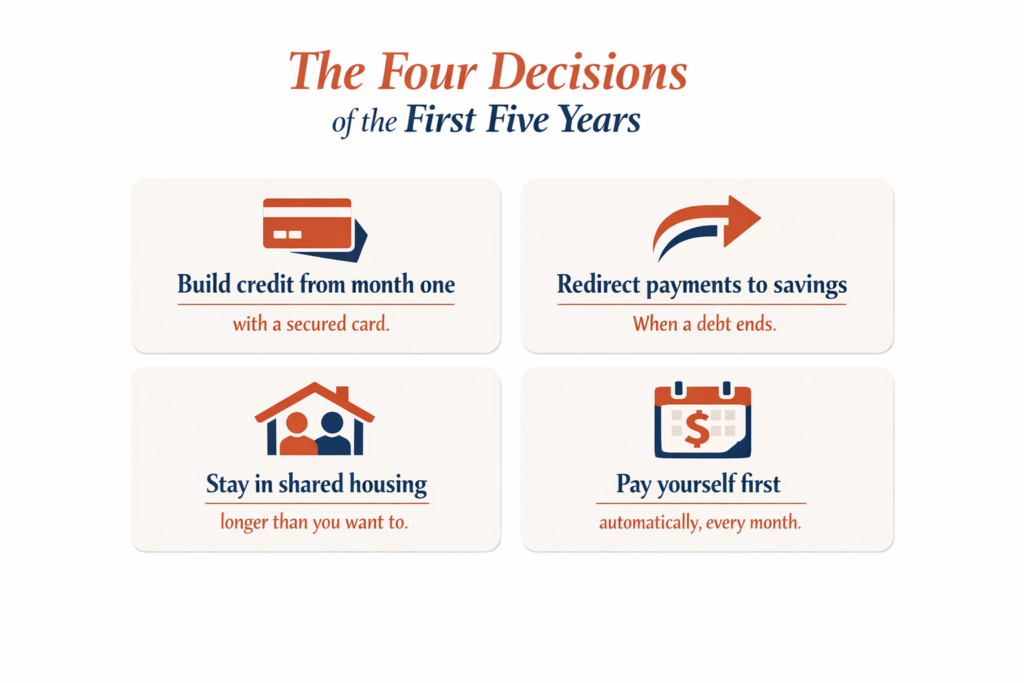
She built credit deliberately from the beginning.
When the agency deductions ended and she had her first real paycheck in full, the first thing she did was open a secured credit card with a $500 deposit. She charged one small purchase to it every month and paid it in full before the due date. She did this for two years before applying for a regular credit card. By year five, her credit score was above 720.
“Nobody told me to do this,” she said. “I saw someone at work do it. I copied her.”
The credit score would matter enormously later — when she applied for her first mortgage, her rate was meaningfully lower than what colleagues with similar incomes but shorter credit histories received.
She paid off the agency debt aggressively, then redirected every dollar of that payment.
When the agency deductions ended at month eighteen, she calculated exactly what that money had been and immediately redirected the same amount into savings. She did not allow her spending to expand to fill the space. This is a behavioral finance principle that she arrived at through instinct rather than study: when an expense disappears, treat the money as already spent, but spend it on your future self.
“I had already been living without it,” she said. “So I kept living without it.”
She shared housing far longer than she wanted to.
For the first four years in the US, Marisol lived with two other Filipino nurses in a three-bedroom apartment. She was in her late thirties and early forties. She had a graduate nursing credential. She wanted her own space. She did not get her own space.
The housing cost was approximately $650 per month including utilities. A one-bedroom apartment in the same area would have cost $1,100. The $450 difference, redirected into savings and early investments every month for four years, represents more than $21,000 before any investment growth.
“I hated it sometimes,” she said. “But I knew what it was for.”
The Remittance Equation: The Problem Nobody Talks About
One of the most consistent features of the mainstream personal finance conversation is the near-total absence of remittance. The assumption embedded in almost every retirement planning framework is that your income belongs to you — that your savings rate is a function of your income and your spending, and that optimizing one or the other is sufficient.
For a significant portion of immigrant workers in the United States, that assumption is false. The income does not entirely belong to them. A portion of it belongs, in a real and ethical sense, to people abroad who depend on it.
Marisol sent between $600 and $900 home every month for the first eleven years of her time in the US. Over that period, she estimates she sent approximately $95,000 to the Philippines. Her parents’ house was built with that money. Her sister is now a nurse in Abu Dhabi because of that money. Her brother owns a small trucking business because of that money.
She does not describe this as a sacrifice. She describes it as the work.
“That money did something real,” she said. “It changed things for real people. I cannot regret it.”
But she also describes the years between year five and year eight as the period when she nearly gave up on the idea of her own financial future entirely. Sending $800 a month while trying to save for a down payment on a house, maintain legal status, and prepare for eventual citizenship costs felt like trying to fill a bucket with a hole in it.
What changed was a reframe.
She stopped thinking about retirement as a destination and started thinking about it as a second obligation — the same category as remittance, the same category as rent.
“Remittance is not optional,” she told me. “I do not ask myself each month whether I want to send it. It goes. I decided retirement had to be the same. Not optional. Not after everything else. First.”
She set up an automatic contribution to her employer-sponsored retirement account — at the time, a 403(b) — for the maximum employer match percentage. This came out of her paycheck before she saw it, the same way a deduction does. It became, in her accounting, invisible — not money she was choosing to save, but money she did not have.
She also, critically, did not reduce this contribution during the months when remittance pressure was highest. When her father was ill and she sent extra. When her sister’s tuition was due. She found the extra money other ways — overtime, reduced spending — and left the retirement contribution untouched.
“That account,” she said, “was the one thing I did not touch. No matter what.”
Year Eight: The Pivot
In 2010, Marisol moved from New Jersey to Houston to take a position in a surgical step-down unit that paid $7 more per hour than her New Jersey salary. Houston’s cost of living, at the time, was significantly lower. The combination of higher income and lower costs created her first real financial breathing room.
She used it to buy a house.
She had saved $43,000 for a down payment — painstakingly, over four years, in a high-yield savings account that she did not touch even when she wanted to. She put 20% down on a three-bedroom home in Pearland. Her monthly mortgage payment was $1,180. Her previous rent share had been $650.
The $530 difference felt enormous.
The decision to put 20% down was deliberate: she wanted to avoid private mortgage insurance, which would have added approximately $180 per month to her payment for years. Over the life of the loan, avoiding PMI saved her more than $8,000.
“I waited longer to buy because of the 20%,” she said. “People told me to just buy sooner with less down. I did not. I think I was right.”
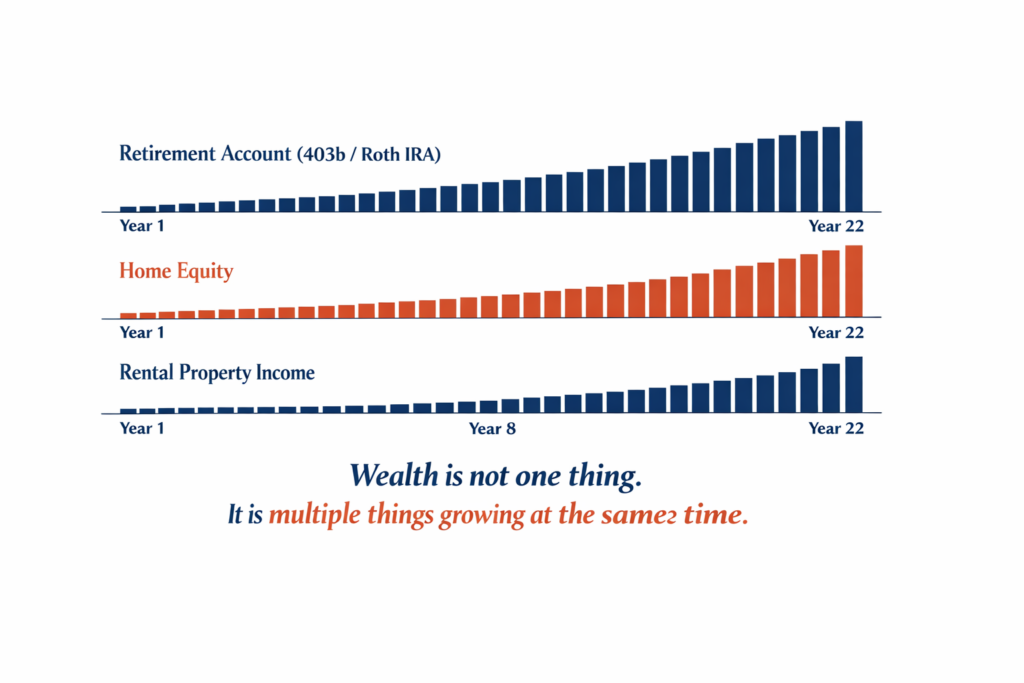
The house also served, she came to understand, a function beyond housing. It was an asset that was building equity simultaneously with her retirement account. Two things growing at once.
Year Fourteen: The Third Track
In 2016, the nurse who had arrived with $400 and a list of phone numbers in her mother’s handwriting bought a second property.
It was a two-bedroom condominium in a suburb of Houston, purchased for $148,000. She put 25% down — the minimum required for an investment property conventional loan. Her monthly mortgage payment was $810. She rented it for $1,350 per month.
The net rental income, after taxes, insurance, and a small property management fee, was approximately $320 per month. This was not, she understood, the point. The point was that someone else was paying down the mortgage on a second asset while it appreciated.
“The rent money is not the real money,” she said. “The equity is the real money. I understood this after a few years.”
She also increased her retirement contributions in 2016, moving from employer-match percentage to the IRS maximum contribution limit. At the time, the 403(b) maximum was $18,000 per year. She hit it.
The compounding that had been building quietly for fourteen years was, by this point, beginning to accelerate in the way that compounding does after a decade — slowly at first, then in a way that starts to feel almost implausible.
What She Did About Taxes That Most People Miss
Marisol is not an accountant. She has worked with the same Filipino-American CPA in Houston for fourteen years, and she attributes a meaningful portion of her financial outcome to that relationship. But she also describes a number of specific tax decisions that she was aware of and made deliberately.
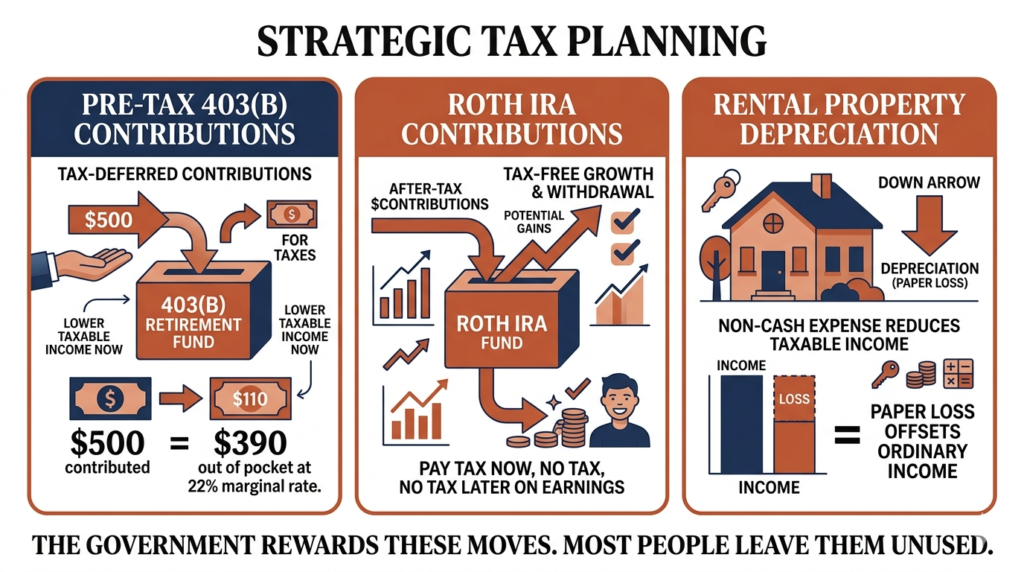
She maximized her pre-tax retirement contributions not only because of the future value but because of the immediate tax reduction. For a nurse in her income bracket, each dollar contributed to a pre-tax retirement account reduced her taxable income by approximately 22 cents at her marginal rate. This meant her actual take-home pay reduction from a $500 monthly contribution was roughly $390. The government, in effect, contributed the other $110.
She also opened a Roth IRA in addition to her 403(b) — the Roth for money she anticipated being in a higher tax bracket when she withdrew it, the 403(b) for money she expected to draw in retirement at a lower rate.
“My CPA explained this to me maybe four times before I understood it,” she said. “But I understood it eventually. And then I was angry that nobody had told me sooner.”
The rental property generated paper losses through depreciation that offset some of her ordinary income — a legitimate tax treatment of investment real estate that she learned about only because her CPA raised it in their annual review.
These are not complicated strategies. They are available to anyone with earned income and a licensed tax professional who understands their situation. What they require is a relationship — a CPA who knows your full picture, not just someone who enters your W-2 into software once a year.
The Remittance Transition
In year eleven, Marisol’s mother passed away. In year thirteen, her father joined her.
The remittance obligation did not disappear — her sister and brother still received support for several more years. But the amount and urgency gradually shifted. By year sixteen, both siblings were financially independent. The $700 or $800 per month she had sent home for a decade and a half became, for the first time, fully hers.
She did not increase her spending. She did not take a vacation she had been postponing. She did not buy a new car.
She increased her retirement contribution by $600 per month and her investment account contribution by $200 per month.
“That money had a job,” she said. “The job changed. The money kept working.”
This is, financial planners will tell you, exactly correct — and exactly what most people do not do. When a financial obligation ends, the money it represented typically disperses into lifestyle inflation before the account holder has time to redirect it deliberately. Marisol did not allow the dispersal. She gave the money its next assignment before the month it was freed.
What Retirement Actually Looks Like
Marisol retired in the spring of her fifty-eighth year. She had planned to work until sixty. Her body, after two decades of night shifts and twelve-hour days, declined to wait.
Her financial position at retirement:
- Paid-off home in Pearland, current estimated value approximately $340,000
- Rental property with $87,000 remaining on the mortgage, generating approximately $520 per month in net income after carrying costs
- Retirement accounts totaling an amount she declined to specify precisely, but which her financial planner has told her can support a comfortable withdrawal rate for thirty or more years
- No debt of any kind
Her monthly income in retirement comes from: the rental property, Social Security (she began collecting at 62 after two years of retirement), and retirement account withdrawals at a conservative rate. She also does occasional per diem nursing shifts — two or three per month — not for financial need, she says, but because she is not ready to leave it entirely.
She did not reach this position because her salary was exceptional. Houston’s nursing salaries are competitive but not outlier-level. She did not benefit from an inheritance or a windfall or a single dramatic investment. She benefited from duration and discipline applied in a particular sequence at particular moments.
“Twenty-two years is a long time,” she said. “But it went. And now it is gone and what I have left is what I built during it.”
The Framework, Made Explicit
Marisol asked me to include something concrete — a version of what she did, in order, that someone starting now could actually use.
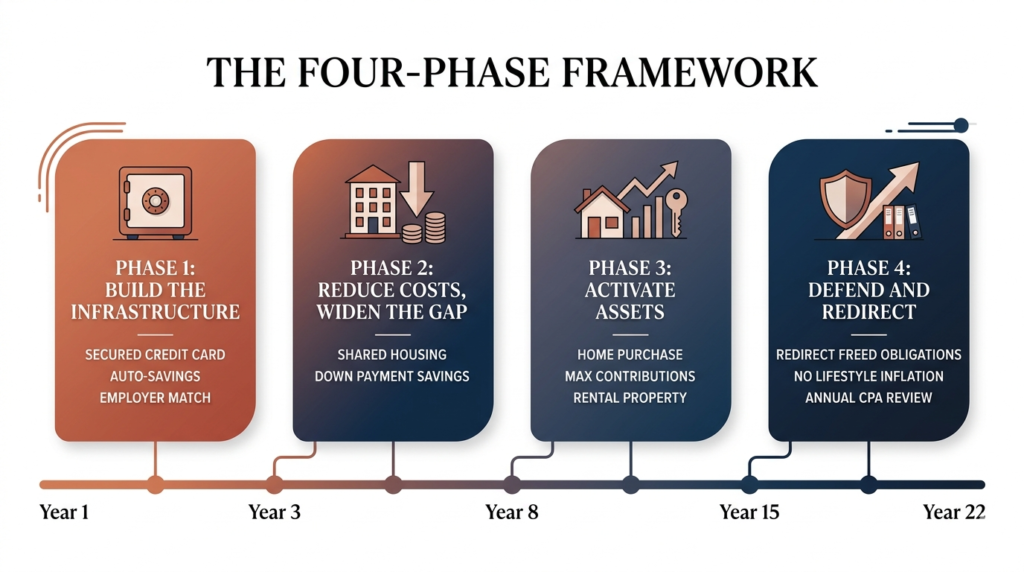
The framework, drawn from her experience and the patterns it represents:
Phase 1, Years 1 through 3: Build the infrastructure. Open a secured credit card immediately. Use it for one small purchase per month and pay in full. Open a savings account and set an automatic transfer for any amount — $50, $100, whatever is possible — on the day after each paycheck. Contribute enough to your employer retirement plan to capture the full employer match. These three actions cost very little and create the financial architecture that everything else runs on.
Phase 2, Years 3 through 8: Reduce fixed costs and grow the gap. The gap between income and expenses is the only number that matters. Reduce fixed costs — housing, especially — to widen it. Stay in shared housing longer than feels comfortable. When an expense ends, redirect it before the month is over. Build a down payment fund and set a target date. Do not invest money you will need within five years.
Phase 3, Years 8 through 15: Activate assets. Buy a primary residence when you have 20% to put down, good credit, and stable income. Maximize your retirement contributions, not just the employer match. Work with a CPA who understands rental income, depreciation, and your specific immigration-related financial situation. Consider a second property when you have equity in the first and clarity on your carrying capacity.
Phase 4, Years 15 through retirement: Defend and redirect. When obligations end — debt is paid, dependents become independent, remittance reduces — redirect every freed dollar before it becomes invisible. Do not expand your lifestyle to fill the space. Increase retirement and investment contributions by the exact amount of the ended obligation. Protect your assets with appropriate insurance. Consult your CPA annually, not just at tax time.
A Note on What This Framework Requires
I want to be honest about what this framework demands, because I think the honest version is more useful than the inspirational version.
It requires a long horizon. Not everyone arrives at thirty-six with twenty-two working years ahead of them. Not everyone has a body that holds up through two decades of night shifts. Not everyone has a workplace with a 403(b) match, or an immigration pathway that leads to permanent residency and eventual Social Security eligibility, or a family situation abroad that resolves toward independence rather than deepening dependency.
Marisol’s outcome was not luck. But it was also not divorced from circumstance. Her nursing credential, earned in the Philippines, transferred to US licensure through a pathway that was available to her in 2002 and has since become more restricted. Her visa category allowed her a clear path to a green card. Her two siblings became financially independent. Her parents died before she did.
None of these things were guaranteed. Some of them were deeply painful. The freedom she has now was built partly on losses — her parents, years of her children growing up in a different country, the particular loneliness of the long-distance life.
“People see where I am now and they think it was worth it,” she said. “It was. But the ‘worth it’ does not mean the cost was small. The cost was very large. I just paid it and I kept going.”
This is the true framework. Not just the financial mechanics, but the decision to keep building regardless of what the building costs.
What She Would Tell Someone Starting Now
I asked her what she would say to a Filipino nurse arriving in the US today — or a Guatemalan home health aide, or a Nigerian lab technician, or anyone entering the immigrant financial experience from the beginning.
She thought for a moment.
“Start the retirement account before you feel ready,” she said. “You will never feel ready. Start it anyway. Start it with whatever the minimum is. It does not matter. Start it.”
“Find a CPA who looks like you or who understands people who look like you. Not because other CPAs are bad. Because there are things about your situation — remittance, immigration costs, the money you send home — that require someone who has seen it before.”
“Do not wait for the remittance to end before you save for yourself. You will be waiting a very long time. The remittance and the savings have to happen at the same time, even if the savings is very small.”
“And do not let anyone make you feel like the money you send home is the reason you can’t build something here. That money is doing something real and important. It does not have to be in competition with your future. Make them both happen at the same time, even when it is hard.”
She paused.
“It will be hard,” she said. “It was hard for me the whole time. Hard is not the same as impossible.”

Marisol’s surname has been withheld at her request. Her story has been shared with her knowledge and full consent. If you are an immigrant worker beginning to build a financial plan, the Consumer Financial Protection Bureau offers free resources in multiple languages at consumerfinance.gov. The IRS Volunteer Income Tax Assistance program (VITA) provides free tax preparation for households earning under a threshold amount and specifically serves immigrant communities.
This article does not mention affiliate-linked services. The financial strategies described here reflect Marisol’s personal experience and are provided for informational purposes only. Please consult a licensed financial planner and CPA before making decisions specific to your situation.