
How Healthcare Works in the US: A Plain Language Guide for Immigrants
The first time I needed to see a doctor in the United States, I spent 45 minutes on the phone before the appointment trying to understand what my insurance card actually meant. In network. Deductible. Copay. Prior authorization. Primary care physician. Referral required. None of these words meant anything to me. Where I grew up, you went to the clinic, you waited, and eventually a doctor saw you. The concept of calling ahead to confirm a provider was “in network” before you could be treated was something I genuinely did not believe was real the first time someone explained it to me.
It is real. And not understanding it is expensive.
The US healthcare system is one of the most complex in the world. It is not a single system, it is a patchwork of private insurance plans, government programs, employer sponsored plans, community health centers, and safety net programs, all with different eligibility rules, different costs, and different levels of access depending on where you live, how much you earn, and your immigration status.
This guide explains how all of it works, in plain language, so that the next time you or someone in your family needs care, you know exactly what to do and what it will cost.
Why Healthcare Feels So Different Here
In most countries, healthcare is either fully government funded (meaning you show up and receive care), partly subsidized through social insurance programs everyone pays into automatically, or built around a simpler fee structure where you pay a clear amount and leave.
The United States is different from all of these. Here, the majority of people receive healthcare through private insurance, and private insurance means that a third party, an insurance company, stands between you and your doctor. Every time you receive care, the insurance company pays a portion and you pay a portion. The amounts, the rules about which doctors you can see, and what treatments are covered all depend on which specific plan you have.
There is not a single form of health insurance in the United States. Instead, the US healthcare system is a combination of publicly and privately funded programs with different requirements and rules for eligibility, depending on factors like where you live, your immigration status, and your income.
Understanding the basic vocabulary is the first step to navigating this system.
The Vocabulary You Need to Know
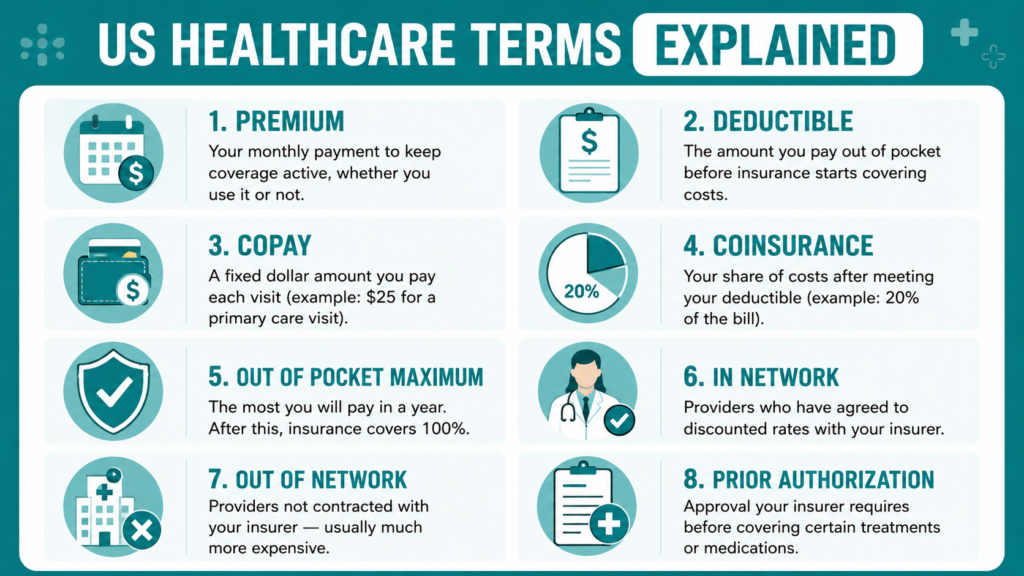
Premium: The amount you pay every month to maintain your health insurance coverage, regardless of whether you use any healthcare that month. Think of it like a subscription fee.
Deductible: The amount you must pay entirely out of your own pocket each year before your insurance begins sharing costs. If your deductible is $1,500, you pay the full cost of medical services until you have spent $1,500 in a given year. After that, your insurance begins to contribute.
Copay: A fixed dollar amount you pay at the time of a visit or service. For example, $25 every time you see your primary care doctor, or $10 for a generic prescription. Copays often apply before your deductible is met for certain services.
Coinsurance: Your share of medical costs after you have met your deductible, expressed as a percentage. If your coinsurance is 20%, your insurance pays 80% of covered services and you pay the remaining 20%.
Out of pocket maximum: The most money you will pay for covered healthcare in a single plan year. Once you reach this ceiling, your insurance covers 100% of covered services for the rest of the year. This is one of the most important numbers to know, it is the ceiling on your worst case financial exposure.
In network vs. out of network: Insurance companies negotiate discounted rates with specific doctors, hospitals, and clinics. These are called in network providers. If you receive care from a provider outside your network, you typically pay significantly more, sometimes the full cost. Always confirm a provider is in network before scheduling any non emergency care.
Primary care physician (PCP): Your main doctor, the one you see for routine checkups, common illnesses, and referrals to specialists. Some insurance plans require you to choose a PCP and get a referral before seeing any specialist.
Prior authorization: Approval that your insurance company requires before it will cover certain expensive treatments, specialist visits, or medications. If you skip this step, your insurance may refuse to pay.
The Four Ways to Get Health Insurance in the US
Option 1: Employer-Sponsored Insurance
This is how most people in the United States get their health coverage, and if your employer offers it, it is usually your best first option.
Your employer negotiates a group insurance plan and typically pays a significant portion of the monthly premium, often 70% to 80% for the employee, though the coverage for family members is usually more expensive and varies widely by employer. Your share of the premium is deducted directly from your paycheck, usually before taxes, which reduces your taxable income slightly.
When you start a new job, you will be asked to choose a health plan during an enrollment window, usually within the first 30 days. Read the plan options carefully before choosing. Compare not just the monthly premium but also the deductible, the out of pocket maximum, the copay for primary care and specialist visits, and whether your preferred doctors and medications are covered.
Although most noncitizen immigrant adults report being employed, they are significantly more likely than citizens to report being lower income and disproportionately employed in low-wage jobs and industries that are less likely to offer employer sponsored coverage. If your employer does not offer insurance, or if the coverage offered does not fit your needs or budget, the following options apply.
Option 2: The ACA Marketplace
The Affordable Care Act Marketplace, often called the ACA Marketplace, the Exchange, or Obamacare, is an online platform where you can shop for and purchase private health insurance plans if you do not have employer sponsored coverage.
Lawfully present immigrants can get Marketplace coverage and may qualify for premium tax credits and cost sharing reductions. A premium tax credit reduces your monthly premium cost on a sliding scale based on your household income. Cost sharing reductions lower your deductible, copay, and coinsurance amounts when you choose a Silver level plan.
The open enrollment window for Marketplace plans runs from November 1 through January 15 in most states each year, with some states having slightly different deadlines. Outside of that window, you can only enroll if you experience a qualifying life event, like losing a job, moving to a new state, getting married, or having a child.
Who qualifies for Marketplace coverage: Most lawfully present immigrants, including green card holders, H-1B and other work visa holders, TPS holders, refugees, asylees, and others with qualifying immigration status. As of August 25, DACA recipients are no longer eligible for Marketplace coverage.
Important change from the One Big Beautiful Bill Act: The reconciliation law passed in July 2025 significantly restricted who can receive financial help purchasing Marketplace coverage. Starting in January, lawfully present immigrants who fall below 100% of the federal poverty level and are in the five year Medicaid waiting period can no longer receive Marketplace subsidies. This change eliminated an important coverage pathway for many newly arrived immigrants.
You can shop for and compare Marketplace plans at healthcare.gov.
Option 3: Medicaid and CHIP
Medicaid is a joint federal and state program that provides free or very low-cost health coverage to people with low incomes. CHIP, the Children’s Health Insurance Program, provides low-cost coverage to children in families that earn too much for Medicaid but cannot afford private insurance.
Eligibility for Medicaid and CHIP is limited to citizens and certain lawfully present immigrants.
Many eligible non-citizens, including most lawful permanent residents or green card holders, must wait five years after obtaining qualified status before they may enroll. Some categories of immigrants do not face this five year waiting period, including refugees, asylees, and citizens of Compact of Free Association (COFA) nations like the Marshall Islands, Micronesia, and Palau.
For children and pregnant people, states can eliminate the five year waiting period for Medicaid and CHIP coverage. As of January 2025, 37 states plus DC have taken up this option for children, and 31 states plus DC have elected the option for pregnant individuals.
Undocumented immigrants are not eligible for federally funded Medicaid, CHIP, or Marketplace coverage. However, Emergency Medicaid reimburses hospitals for emergency care they are obligated to provide to individuals who meet other Medicaid eligibility requirements such as income but do not have an eligible immigration status. This means that if you have a medical emergency and require hospital care, the hospital cannot turn you away based on your immigration status or inability to pay, it is required by federal law to stabilize you.
A critical note on public charge: Applying for or getting Medicaid or CHIP benefits or getting savings for Marketplace health coverage does not make you a public charge and will not affect your chances of becoming a lawful permanent resident or US citizen. There is one exception for people receiving long-term institutional care at government expense. For most healthcare programs, accessing benefits you qualify for has no immigration consequences.
To find out if you qualify for Medicaid in your state, visit your state’s Medicaid agency website or healthcare.gov.
Option 4: Community Health Centers and Safety-Net Providers
Regardless of your immigration status or ability to pay, Federally Qualified Health Centers (FQHCs) are community health centers required by law to provide care to anyone who comes through their door, regardless of documentation status or ability to pay. They charge on a sliding scale based on income, meaning you pay what you can afford, and for very low income patients, that can be close to zero.
Community health centers provide primary care, preventive care, dental care, mental health services, and prescription medications. They are not emergency rooms, they are neighborhood clinics that provide the kind of routine care that keeps small problems from becoming expensive emergencies.
To find a federally qualified health center near you, go to findahealthcenter.hrsa.gov. This is one of the most underused resources in immigrant communities and one of the most important.
How to Use Your Insurance Once You Have It
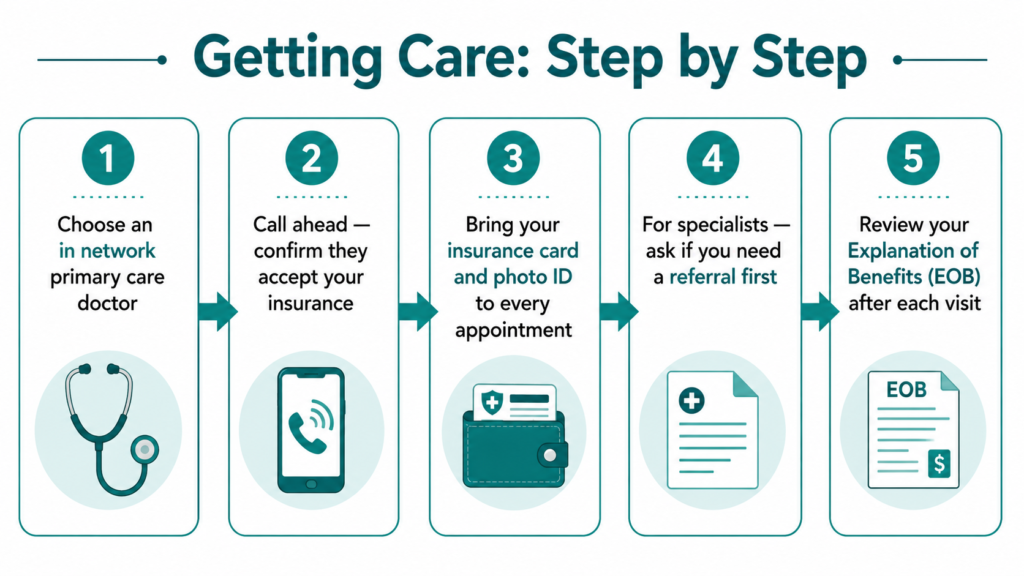
Having insurance is step one. Knowing how to use it correctly is step two, and many immigrants with coverage still end up paying more than they should because of how they access care.
Always confirm in network status before a non emergency visit. Call your insurance company (the number is on the back of your card) or use your insurer’s online provider directory. Ask directly: “Is this provider in network for my specific plan?” Getting care from an out of network provider, even accidentally, can result in bills many times higher than what in network care would would cost.
Choose a primary care physician and establish care. Many immigrants use the emergency room as their primary point of contact with the healthcare system, partly because they do not know they have other options and partly because emergency rooms cannot turn you away. But emergency room care is the most expensive care available, and a visit for a non emergency condition can result in a bill of several hundred to several thousand dollars even with insurance. A primary care clinic visit for the same issue typically costs a $25 to $50 copay.
Understand the referral process. If you have an HMO plan (Health Maintenance Organization), you generally cannot see a specialist without a referral from your primary care physician. Seeing a specialist without a referral in an HMO plan can result in the visit being denied coverage entirely. A PPO plan (Preferred Provider Organization) is more flexible, you can typically see specialists without a referral, though staying in-network is still important for cost reasons.
Read your Explanation of Benefits (EOB) after every visit. After any medical service, your insurance company sends you an Explanation of Benefits, a document showing what was billed, what your insurance paid, and what you owe. This is not a bill, but it tells you what the bill will look like. Errors on EOBs happen more often than most people realize. If something looks wrong, a service you did not receive, a charge that does not match what you were told, contact your insurer to dispute it.
Know that you can negotiate medical bills. If you receive a bill you cannot pay, call the billing department of the hospital or clinic and ask about financial assistance programs, payment plans, or charity care. Most hospitals, particularly nonprofit hospitals, are required to have charity care programs for low income patients. Many will significantly reduce or even eliminate bills for patients who meet income thresholds. This is a right, not a favor. Ask explicitly.
Prescription Medications: How to Spend Less
Prescription drug costs in the US are a source of genuine financial hardship for many families. A medication that costs $20 per month in most developed countries can cost $200 or more without insurance. Even with insurance, brand name drugs can be expensive.
A few strategies that reduce costs significantly:
Always ask for the generic version. Generic medications contain the same active ingredient as brand name drugs and are FDA-regulated for safety and effectiveness. They typically cost a fraction of the brand name price.
Use GoodRx before you fill any prescription. GoodRx is a free app and website that shows you the lowest available price for any prescription at pharmacies near you. In many cases, paying the GoodRx cash price, without using insurance at all, is cheaper than your insurance copay. Check GoodRx every time.
Use the prescription drug coverage tier list. Every insurance plan has a formulary, a list of covered medications organized by tiers, with lower tiers costing less. Ask your doctor if a lower tier medication would work equally well for your condition.
Ask your doctor for samples. Pharmaceutical companies provide doctors with free samples of medications, particularly newer brand name drugs. If cost is a concern, ask your doctor directly whether samples are available.
Look into manufacturer patient assistance programs. Most major pharmaceutical companies offer programs that provide their medications free or at very low cost to patients who cannot afford them. NeedyMeds.org maintains a searchable database of these programs.
Mental Health Coverage: What You Are Entitled To
Under the Mental Health Parity and Addiction Equity Act, health insurance plans in the United States are required to cover mental health and substance use disorder services no more restrictively than they cover physical health services. In theory, if your plan covers 10 doctor visits per year for a broken arm, it must also cover at least 10 therapy visits per year.
In practice, mental health services are often harder to access because there are fewer in network mental health providers than primary care physicians in most areas. If your insurer’s directory shows no in network therapists in your area or with availability, you have the right to request an exception or ask for out of network coverage at in network rates, a process called a network adequacy complaint.
For immigrants specifically, culturally responsive mental health care, care provided by a therapist who understands your cultural background, speaks your language, or has experience working with immigrant populations, can be harder to find but is worth seeking. Open Path Collective (openpathcollective.org) offers reduced-rate therapy for people who cannot afford standard rates. The SAMHSA National Helpline (1-800-662-4357) is free, confidential, and available 24 hours a day in English and Spanish.
What Has Changed Recently: Healthcare and Immigrants
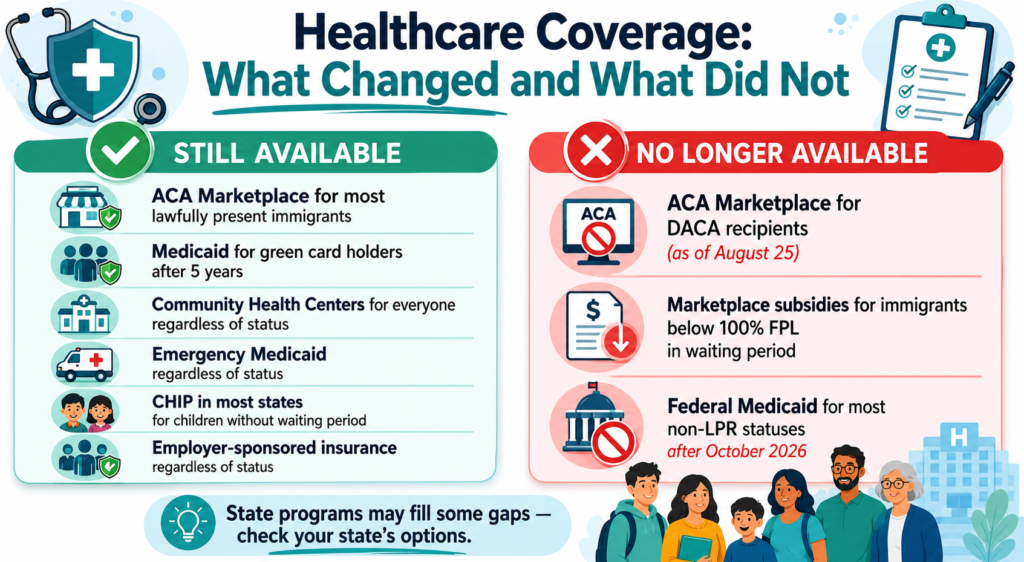
The healthcare landscape for immigrants changed significantly with the One Big Beautiful Bill Act signed in July 2025. Here is an honest summary of what changed and what did not.
As a result of the law, more than one million lawfully present immigrants will lose access to affordable Marketplace health coverage, Medicaid, or Medicare beginning later this year.
Specifically:
DACA recipients are no longer eligible for ACA Marketplace coverage as of August 25.
Starting October 1, states can only receive federal matching funds to cover a narrow group in Medicaid and CHIP: US citizens, lawful permanent residents after completing the five-year bar when applicable, people from COFA nations, and Cuban and Haitian entrants.
The elimination of Marketplace subsidies for lawfully present immigrants below 100% of the federal poverty level during the Medicaid waiting period removes a coverage option that had been available for over a decade.
What did not change:
Community health centers remain open to everyone regardless of status. Emergency Medicaid remains available for stabilizing emergency care. Many states have their own separately funded coverage programs that are not affected by federal changes. Colorado’s OmniSalud program covers adults regardless of immigration status. California, Illinois, New York, and Washington offer state funded programs for immigrants who do not qualify for federal coverage. The District of Columbia’s Healthcare Alliance provides coverage to low income adults regardless of immigration status.
If you live in a state with its own coverage program, check your state’s Medicaid and health department websites for current eligibility rules, these change more frequently than federal rules and are often more generous than the federal baseline.
A Simple Roadmap: What to Do If You Need Healthcare Right Now
If you have employer sponsored insurance: Call the number on the back of your insurance card. Confirm your benefits and find an in network primary care doctor. Schedule an appointment.
If you have Marketplace insurance: You have a primary care network you can access. Use your insurer’s website to find in network providers in your area.
If you have Medicaid: Use your Medicaid card at any provider who accepts Medicaid. Your state’s Medicaid website lists participating providers.
If you have no insurance and are a lawfully present immigrant: Visit healthcare.gov to see if you qualify for Marketplace coverage or Medicaid in your state. Visit findahealthcenter.hrsa.gov to find a community health center near you that sees patients regardless of ability to pay.
If you have no insurance and are undocumented: Community health centers serve you regardless of documentation status. Emergency rooms cannot turn you away for emergency care. Local free clinics and nonprofit health organizations serve undocumented immigrants in most major cities, search “free clinic” plus your city name to find options.
If you are facing a medical bill you cannot pay: Ask the billing department for a financial assistance application before you pay anything. Most hospitals have charity care programs. Ask what income thresholds apply. Many immigrants qualify for significant bill reductions they never ask about.
The One Thing That Will Save You the Most Money
Of everything in this guide, the single habit with the greatest financial impact is this: establish care with a primary care physician and see them regularly for preventive care.
Preventive visits, annual physicals, vaccinations, screenings, are typically covered at 100% with no copay under most insurance plans, because insurance companies have figured out that catching problems early costs them far less than treating them after they have become serious.
The immigrants who end up with the largest medical bills are almost always those who delayed care because they did not understand the system, did not have insurance they knew how to use, or were afraid of the cost. By the time they sought care, a manageable problem had become an expensive one.
The system here is complicated. But it is navigable. And the more you understand it, the more money you save, and the healthier you and your family stay.
Useful Resources
Healthcare.gov — Shop for and enroll in Marketplace coverage, check Medicaid eligibility.
findahealthcenter.hrsa.gov — Find a federally qualified health center near you.
GoodRx.com — Find the lowest prescription drug prices in your area.
NeedyMeds.org — Find patient assistance programs for medications you cannot afford.
SAMHSA National Helpline — 1-800-662-4357, free and confidential, English and Spanish, 24 hours a day.
Benefits.gov — Search for all government benefit programs you may qualify for based on your situation.
Disclaimer: This article is for educational and informational purposes only and does not constitute medical, legal, or financial advice. Healthcare eligibility rules for immigrants change frequently, particularly following recent legislative changes. Always verify current eligibility directly with the relevant program or a qualified navigator before making coverage decisions.