Second Chance Banking: What to Do if You’re Denied a Bank Account
You gathered your documents. You walked into the branch. You sat across from a representative who typed your information into a screen, looked at something you could not see, and told you the account could not be opened.
No explanation. Just no.
For many immigrants, that moment is confusing and deflating in equal measure. You did not bounce checks. You did not miss payments. You have no idea what you did wrong because nobody told you the system was even checking for something beyond your passport and your address.
Here is what was happening: most banks in the United States run your information through a consumer reporting system called ChexSystems before approving any new account. ChexSystems tracks negative banking history, including unpaid overdraft fees, accounts closed with a balance owed, suspected fraud, and bounced checks. If a previous bank reported anything against your name or your Social Security Number in the past five years, that record can trigger an automatic denial, even if your credit score is excellent and you currently have steady income.
For immigrants, ChexSystems problems most commonly arise from a few specific situations: a first account opened without understanding overdraft fees, an account that was never properly closed before leaving a previous city, a fraud incident on an old account, or in some cases an error where your ITIN or SSN was matched to someone else’s negative record.
The good news is that a ChexSystems flag does not lock you out of banking permanently. You have real options. This article walks through every one of them.
Step 1: Understand Why You Were Denied
Before you do anything else, find out exactly what triggered the denial. Banks are not required to explain their decisions in detail, but federal law gives you the right to a free copy of your ChexSystems report.
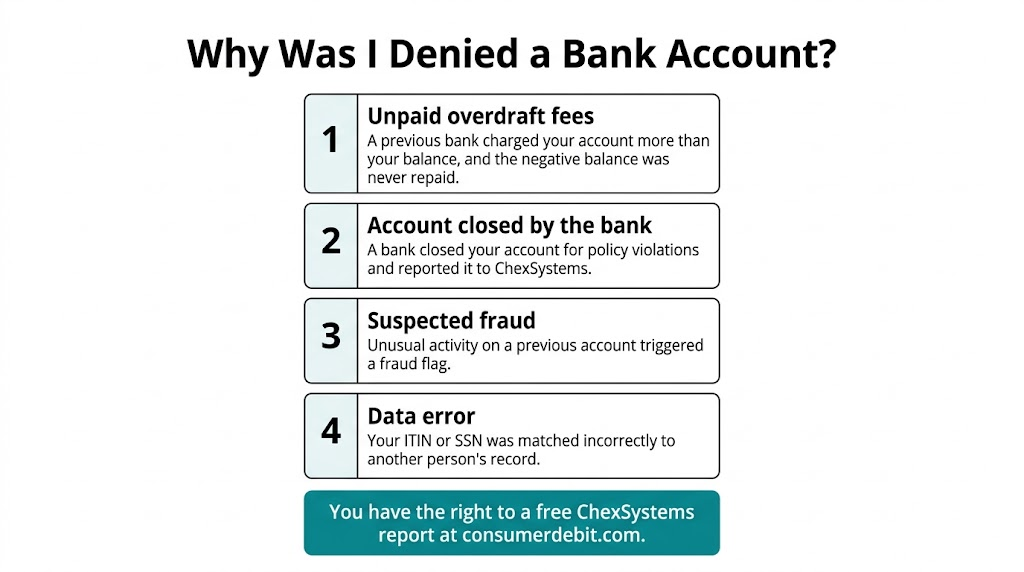
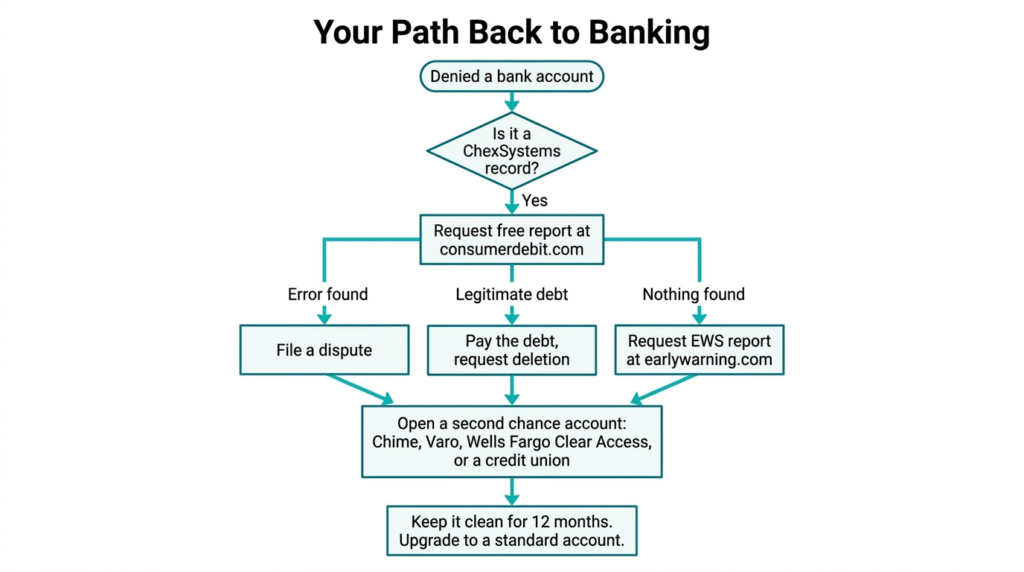
Request your free ChexSystems report at consumerdebit.com. You are entitled to one free report every 12 months, and you can also request one within 60 days of a denial. The report will show exactly what was reported, by which institution, and on what date.
Read it carefully. Three things can happen after you read it.
You find an error. Errors are more common than people realize, particularly for immigrants whose names, ITINs, or Social Security Numbers are similar to those of other people in the system. If you find an inaccuracy, you have the right to dispute it directly with ChexSystems and with the bank that submitted the record. ChexSystems is required to investigate disputes within 30 days. If the error is confirmed, it must be corrected or removed.
You find a legitimate negative record. If an old bank correctly reported an unpaid overdraft or a closed account with a balance owed, contact that bank directly. Ask what it would take to resolve the debt. Many banks will request removal of the ChexSystems record once the outstanding balance is paid, particularly if you ask for that specifically in writing. Paying an old bank debt and then asking for a ChexSystems deletion is one of the most effective paths to clearing your record faster than the standard five-year window.
You find nothing. Some banks use a separate system called Early Warning Services (EWS) rather than ChexSystems. If your ChexSystems report is clean but you were still denied, request your EWS report at earlywarning.com. You are also entitled to a free copy of that report annually.
Step 2: Open an Account That Does Not Require a Clean ChexSystems Record
While you are working on clearing your record, you need a bank account now. The good news is that you do not have to wait five years for a ChexSystems negative record to fall off before you can access banking. Several types of accounts are specifically designed for people in your situation.
Option 1: Digital Banks That Skip ChexSystems Entirely
Several neobanks and digital banking platforms do not use ChexSystems in their account screening process at all. This makes them the fastest and often the best path to a working bank account while you address your banking history.
Chime does not use ChexSystems when screening new account applicants. It offers a free checking account with no monthly fees, no minimum balance, early direct deposit, and a linked savings account. Chime is one of the most widely recommended options for people who have been denied elsewhere, and it is available to anyone with a valid SSN and a US address. There are no overdraft fees on standard transactions, which helps prevent the cycle that created the problem in the first place.
Varo is another digital bank that does not use ChexSystems. It offers a free account with no monthly fees, high interest on savings, and no minimum balance requirements. Like Chime, Varo is built around a mobile app with features designed to help people build better financial habits, including automatic savings tools and spending alerts.
GO2bank, operated by Green Dot, offers a second chance account with no minimum balance requirement. There is a $5 monthly fee unless you have direct deposit set up, at which point the fee is waived. GO2bank also provides early direct deposit and a high yield savings option.
For a full comparison of digital banking options available to immigrants at different stages, our guide on best bank accounts for migrants covers the specific accounts worth considering based on your documentation and situation.
Option 2: Second Chance Checking Accounts at Traditional Banks
Some traditional banks offer accounts specifically designed for people with negative banking history. These are called second chance checking accounts, and while they typically come with more restrictions than standard accounts, they provide real banking services while you rebuild your record.
Wells Fargo Clear Access Banking is one of the most widely available second chance accounts at a major bank. It has a low monthly fee of $5 that cannot be waived, does not allow overdrafts, and does not offer checkwriting. But it provides a debit card, direct deposit, mobile banking, and access to Wells Fargo’s extensive branch and ATM network. For immigrants who need in-person banking support, this is a meaningful advantage over digital-only options.
Capital One 360 Checking stopped using ChexSystems when screening applicants in 2014. It has no monthly fees and no minimum balance, and functions as a full featured checking account. This is technically not a second chance account but it has the same practical effect: it accepts applicants regardless of their ChexSystems record.
Chase Secure Banking is offered by Chase and does not use ChexSystems, though it does use Early Warning Services. It charges a $4.95 monthly fee that cannot be waived and does not allow overdrafts or checkwriting, but it provides access to Chase’s branch network and a full featured mobile app.
Option 3: Credit Unions With Second Chance Programs
Many local and regional credit unions offer second chance checking programs that are more flexible than those at large banks. Credit unions are nonprofit cooperatives owned by their members, and they have a stronger tradition of working with people the traditional banking system has excluded.
The Juntos Avanzamos network of credit unions is worth specific mention for immigrants. These credit unions have a specific commitment to serving immigrant communities, often accept ITIN holders and consular identification cards, and offer member services in Spanish and other languages. Many Juntos Avanzamos credit unions offer second chance accounts or will review your banking history on a case-by-case basis rather than relying solely on an automated ChexSystems decision.
To find a Juntos Avanzamos credit union near you, visit juntosmembers.org.
Step 3: If You Cannot Open Any Account Yet, Use These Bridges
In rare cases, particularly when the ChexSystems or EWS record involves fraud flags rather than simple unpaid fees, it may take some time before any institution will open a standard account. In that situation, you need short-term alternatives that let you function financially while you work on the underlying problem.
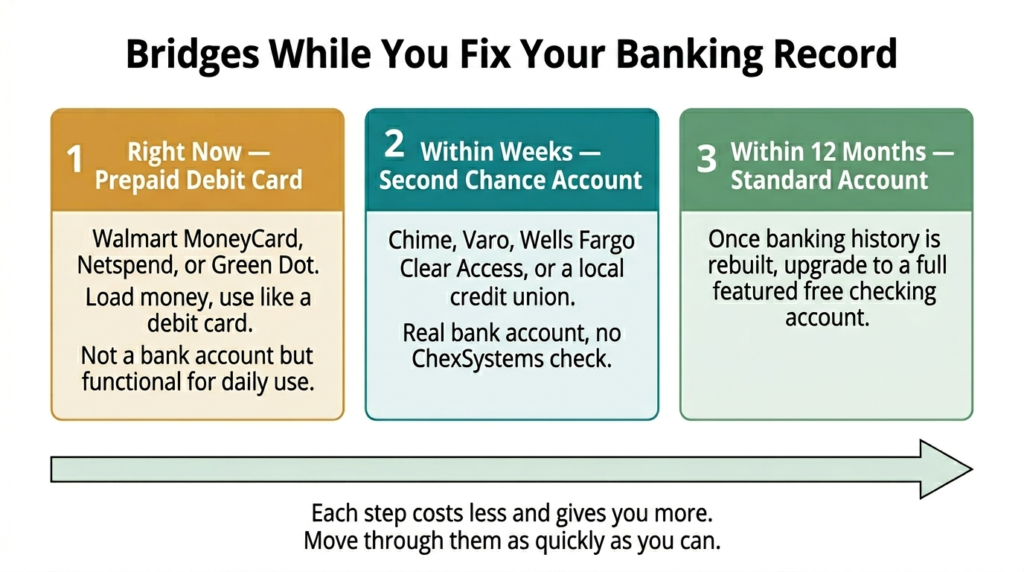
Prepaid debit cards are not bank accounts, but they function like one for most daily transactions. You load money onto the card and spend from it using a debit card. They are accepted for most purchases, can receive direct deposit at many employers, and do not require any banking history check.
The main drawbacks are fees: most prepaid cards charge monthly fees, ATM withdrawal fees, and reload fees that add up quickly. The Walmart MoneyCard, Netspend, and Green Dot are among the most widely available options. Use one only as a temporary bridge, not a long-term solution, because the fees are significantly higher than a free bank account.
Cash App and PayPal both offer accounts with debit card functionality that can receive direct deposit and hold a balance. They do not use ChexSystems and are easier to open than any traditional bank account. Their limitations include no FDIC insurance on your balance in all cases and limited ATM access. Verify the current FDIC status of any cash management account before relying on it.
Step 4: Rebuild Your Banking Record Systematically
Once you have an account open, the path back to a clean banking history is straightforward. It just requires consistency over time.
Never overdraft. Set your new account to decline transactions when your balance is insufficient, rather than approving them and charging a fee. Most digital banks offer this automatically. At traditional banks, call and confirm you are opted out of overdraft coverage.
Set up low balance alerts. Most banking apps allow you to receive a notification when your balance drops below a threshold you set. Put it at $50 or $100. Knowing the balance is low before you spend prevents the overdraft that created the problem in the first place.
Use direct deposit. Having your paycheck deposited directly into your account establishes a consistent, verifiable banking relationship. Many banks track this as a positive signal when reviewing your account history.
Let the account age. The most powerful thing you can do is keep the account open, use it regularly, and never create a new negative incident. A clean 12-month history at a second chance account is typically enough to qualify for a standard account at most institutions. Many second chance accounts have an explicit upgrade pathway: after 12 months of good standing, your account automatically converts to a standard checking account.
Monitor your ChexSystems report. Check your report once a year. Verify that the negative item is still accurately reported with the correct date. If the original debt was from more than five years ago, it should have fallen off. If it has not, dispute it directly with ChexSystems.
The Connection Between Banking and Everything Else
A bank account is not just a place to store money. For immigrants, it is the infrastructure that everything else is built on.
Without a bank account, you cannot set up direct deposit, which means check cashing fees every pay period. You cannot open a credit card, which means no credit history builds and you pay more for cars, apartments, and loans for years. You cannot use digital transfer apps funded from a bank account, which means higher fees and the new 1% remittance cash tax on international transfers. You cannot save in a high yield savings account. You cannot invest through a brokerage. You cannot receive a tax refund by direct deposit.
Every week you spend outside the banking system costs you money in fees and costs you time in rebuilding the financial foundation that everything else requires.
This is why fixing a banking problem is not a secondary concern. It is a top priority financial task.
For context on how banking fits into the broader picture of financial mistakes that cost immigrants money in their first years, our article on the 7 biggest financial mistakes immigrants make covers the full set of decisions that determine your financial trajectory here.
And once your account is open and stable, the next step toward financial health is beginning to build your US credit score. Our guide on secured credit cards for beginners with no credit walks through exactly how to do that from zero.
Quick Reference: Second Chance Banking Options at a Glance
| Account | Type | Monthly Fee | ChexSystems? | Best For |
|---|---|---|---|---|
| Chime | Digital bank | None | Not used | Fee free access, mobile first |
| Varo | Digital bank | None | Not used | Savings features, no fees |
| GO2bank | Digital bank | $5 (waived with direct deposit) | Not used | Early direct deposit |
| Capital One 360 | Traditional bank | None | Not used | Full features, no fees |
| Wells Fargo Clear Access | Traditional bank | $5 (not waivable) | Not used | Branch access, in person support |
| Chase Secure Banking | Traditional bank | $4.95 (not waivable) | Uses EWS not ChexSystems | Chase branch network |
| Juntos Avanzamos credit unions | Credit union | Varies | Often flexible | Immigrant specific services |
Disclaimer: This article is for educational and informational purposes only and does not constitute financial or legal advice. Banking products, fees, account features, and ChexSystems policies change frequently. Always verify current terms directly with any financial institution before opening an account.