
How to Create Your First Budget in America
The first month I lived in the United States, I had no idea where my money was going.
I knew the number on my paycheck. I knew the number in my bank account at the end of the month. The space between those two numbers was a complete mystery to me. Rent came out. Groceries happened. Some weeks I had money left over and felt fine. Other weeks I did not, and felt a quiet panic I could not explain because I had not actually tracked anything closely enough to know why.
A budget fixed that. Not because it made me richer overnight, but because it gave me a map of a financial landscape I did not yet understand. I could finally see where the money went, decide whether that matched what I actually wanted, and adjust before a problem became a crisis instead of after.
If you are newly arrived and have never built a budget in this country, this article walks you through exactly how to do it, starting from nothing, using a method that works whether your income is steady or unpredictable.
Why Building a Budget Here Is Different From Back Home
Before the practical steps, it helps to understand why this feels harder than it should.
Every country has its own rhythm of income and expenses. Maybe you were paid monthly before and now you are paid biweekly. Maybe rent included utilities before and now it does not. Maybe healthcare was free or built into your taxes before and now it is a separate, unpredictable cost. Maybe groceries were a smaller share of your spending before and now, in a country with higher food prices, they take up far more of your paycheck than you expect.
None of your old instincts about what things should cost transfer cleanly. This is not a personal failure. It is the predictable result of every financial system you previously understood being replaced by one you have not learned yet.
A budget is how you learn it quickly, deliberately, and on your own terms, rather than by accident over a year of confusing months.
Step 1: Find Your Real Number
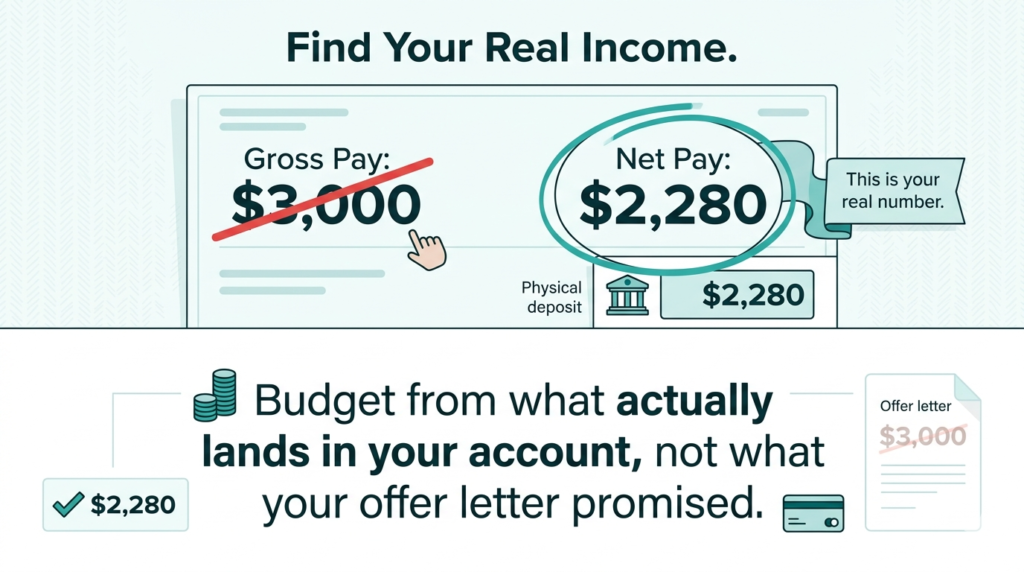
Before you can build a budget, you need to know your actual monthly income, and this is the step most newcomers get wrong without realizing it.
Your real number is your net pay, also called take home pay. This is what is left after federal taxes, Social Security, Medicare, state taxes, and any benefits deductions are removed from your paycheck. It is almost always 25 to 35% lower than your gross salary, the number on your offer letter.
If your income is steady, pull your last one to three pay stubs and add up the actual deposits. If you are paid biweekly, multiply by 26 and divide by 12 to find your monthly average, since biweekly pay does not divide evenly into months.
If your income is irregular, meaning you work gig jobs, freelance, or have variable hours, use your lowest typical month from the past three months as your baseline rather than your best month. Budgeting against your highest earning month sets you up to overspend in the months that do not match it.
If you are still unclear about what each line on your pay stub actually means, our guide on your first US pay stub explained breaks down every deduction so you know exactly where your real number comes from.
Step 2: Track Where Your Money Is Actually Going
You cannot build an honest budget without first knowing your honest spending. For one full month, or by reviewing your last one to three months of bank and card statements, write down every expense and sort it into one of three categories.
Needs: Rent, groceries, utilities, transportation, phone, insurance, minimum debt payments, and anything you must pay to maintain a basic stable life.
Wants: Restaurants, entertainment, subscriptions, shopping, and anything that improves your life but is not strictly required.
Future you: Savings, an emergency fund, investments, and extra debt payments beyond the minimum.
Go through your statements line by line. Be honest rather than aspirational. If you are spending $40 a week on coffee and food delivery, write down $160 a month, not the $40 you wish it were.
This step alone, simply seeing the real numbers in front of you for the first time, is often the most clarifying moment in the entire process. Most people are not overspending wildly. They are leaking small amounts across many categories that add up to something significant by the end of the month.
Step 3: Use the 50/30/20 Framework as Your Starting Point
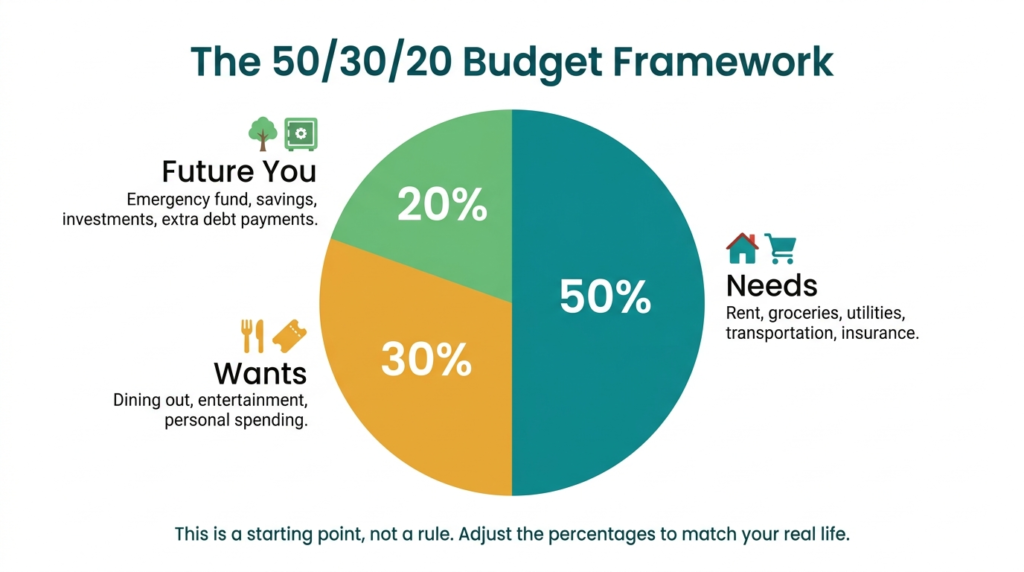
The 50/30/20 rule is the most widely used budgeting framework in the United States, popularized by Senator Elizabeth Warren and her daughter Amelia Warren Tyagi in their book on household finances. It splits your net income into three categories: 50% for needs, 30% for wants, and 20% for future you, meaning savings, investing, or paying down debt faster.
The appeal of this framework is its simplicity. You do not need complicated spreadsheets or financial training to use it. You need your real monthly income and a willingness to sort your spending honestly into three buckets.
Here is how to apply it with real numbers. If your net monthly income is $3,000, your target breakdown looks like this: $1,500 for needs, $900 for wants, and $600 for future you.
Compare that target to what you actually tracked in Step 2. The gap between your target and your reality is where your work begins.
Why the Standard Percentages Often Do Not Fit Newcomers
Real life rarely fits neatly into thirds, and this is especially true for someone newly arrived in a high cost country. Housing costs alone in many US cities can consume 40 to 50% of net income on their own, before any other need is considered.
If your essentials are taking up more than 50% of your income, that is not a failure on your part. It is a signal that your specific situation needs its own proportions rather than forcing the standard split. Many financial educators now recommend variations like 60/20/20 or 70/20/10 for people facing higher cost burdens, particularly in the first year after a move.
The point of the framework is not to hit the exact percentages. The point is understanding where your money is going and making conscious decisions about the gap between your needs, your wants, and your future, even if your specific ratios look different from the textbook version.
Step 4: Adjust the Framework to Your Actual Situation
If your needs genuinely consume 60% or 65% of your income because of high rent in your city, your first move is not to panic but to adjust the model honestly. Try a 60/20/20 split instead, putting 60% toward needs, trimming wants down to 20%, and protecting that 20% for your future. If even that feels unmanageable in your first months, a 70/20/10 split that keeps savings smaller but non-zero is far better than abandoning the idea of saving entirely.
The non-negotiable piece, regardless of which percentages you land on, is protecting some slice for your future. Even 5% matters. Even 10% matters more. Going to 0% because the math feels impossible in month one means you never start the habit at all, and the habit is the part that compounds.
If you are also sending money to family in another country, build that into your needs or future categories explicitly rather than letting it float as an undefined expense that quietly eats into everything else. Treating remittances as a fixed, planned line item rather than a reactive one protects both your obligations and your own financial stability.
Step 5: Build Your Emergency Fund First, Inside Your “Future You” Category
Before any other savings goal, your first 20% (or whatever percentage you have allocated to future you) should go toward an emergency fund.
An emergency fund is money set aside specifically for unplanned expenses: a car repair, a medical bill, a gap between jobs, an emergency flight home. As a general guideline, three to six months of essential living expenses is the target, though this is rarely realistic in your first months and should be treated as a destination you build toward gradually rather than a number you need immediately.
Start small. Even $500 saved specifically as an emergency buffer changes how you experience financial stress, because an unexpected $300 expense no longer means choosing between groceries and rent. It just means dipping into a fund that exists exactly for that purpose.
If you are also navigating the broader question of how to make enough money to cover your needs at all, our honest breakdown in how do I make enough money to survive here covers practical income strategies by timeline, from immediate gig work to longer term skill building.
And if a sudden job loss is what triggered your need for a tighter budget in the first place, our guide on what to do as an immigrant after losing your job walks through the immediate financial and practical steps to take.
Step 6: Pick a Tool and Make It Effortless
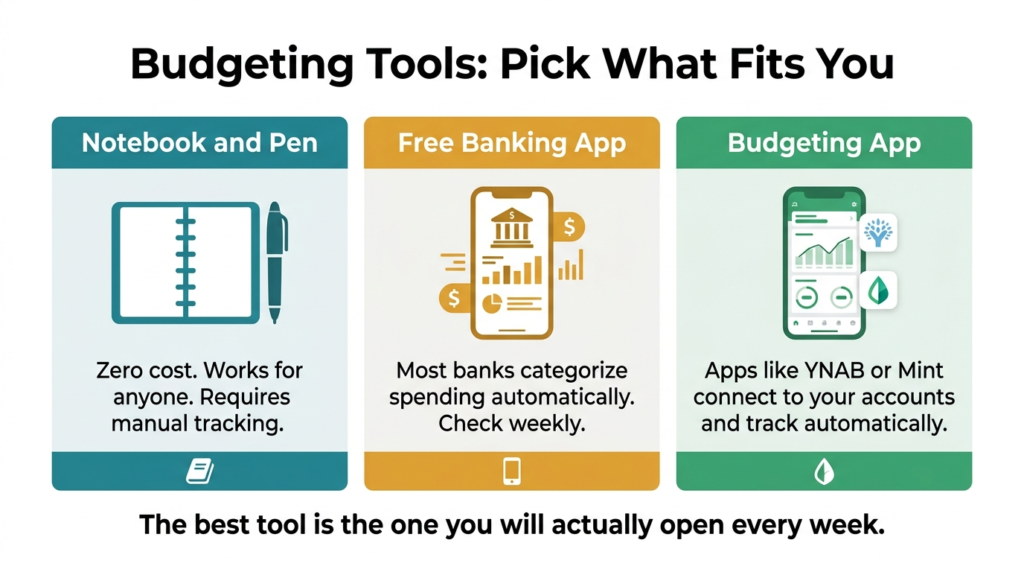
The budgeting method you choose matters far less than whether you will actually use it consistently. Here are three options, in order of complexity.
A notebook and a pen. This costs nothing and works for anyone regardless of banking setup or technology comfort. Write your three categories at the top of a page each month. Log expenses as they happen or once a week from your memory and receipts.
Your bank’s free app. Most US banks and digital banks automatically categorize your spending into groups like groceries, dining, and transportation. Check it weekly rather than monthly to catch problems early. Our comparison of digital banks versus traditional banks for immigrants can help you choose the right banking setup if you have not yet settled on one.
A dedicated budgeting app. Apps connect directly to your bank account and automatically sort your transactions, track your progress against your targets, and send alerts when you are approaching a limit in any category. These take a bit more setup time but reduce the ongoing manual work significantly.
Whichever tool you choose, the habit that matters most is checking your numbers at least once a week, not once a month. A weekly check lets you catch and correct a problem while it is still small. A monthly check often means discovering the problem only after it has already become expensive.
Step 7: Set Up Three Accounts to Make the Budget Automatic
A budget written on paper is a plan. A budget supported by the right account structure is a system that runs largely on its own.
Consider opening, or using, three separate accounts:
Account one: Bills and needs. Your paycheck lands here, and your rent, utilities, and other fixed costs are paid automatically from this account.
Account two: Spending money. Transfer your wants budget here at the start of each pay period. Once it is empty, you know you have spent your allocation for that period, without needing to check a spreadsheet.
Account three: Future you. A separate savings account, ideally a high yield savings account, where your future you percentage is automatically transferred the same day your paycheck arrives.
This separation works because it removes the burden of willpower from your daily decisions. You are not constantly calculating whether you can afford something. You are simply checking whether the money is still in the spending account. If it is gone, the answer is no, without needing a debate.
Step 8: Review and Adjust Every Month, Not Just Once
Your first budget will be wrong in some way, and that is completely normal. Maybe you underestimated how much groceries actually cost in your new city. Maybe a category you thought was small turned out to be significant. The first month of any new budget is a research project, not a finished product.
At the end of each month, compare what you planned to what actually happened. Adjust your categories based on real data rather than guesses. Over two to three months, your budget will increasingly reflect your actual life rather than an estimate of it, and that accuracy is what makes a budget genuinely useful rather than aspirational.
Once your budget is stable and your emergency fund is growing, the natural next step is putting your future you percentage to work. Our guide on how to start investing in the US with $100 picks up exactly where this article leaves off.
A Quick Reference: Your First Budget in Five Numbers
| Step | What to Find | Where to Look |
|---|---|---|
| 1. Real income | Your net pay, not gross salary | Recent pay stubs |
| 2. Real spending | Total of needs, wants, and future you from last month | Bank and card statements |
| 3. Target split | 50/30/20 or an adjusted version for your situation | Your real income number |
| 4. Emergency fund target | Three to six months of needs (build gradually) | Your needs total from Step 2 |
| 5. Review point | Monthly comparison of plan versus actual | Your chosen tracking tool |
The Honest Truth About Budgets in a New Country
A budget will not erase the real financial pressure of building a life in an unfamiliar, often expensive country. It will not make rent cheaper or grocery prices lower. What it does is give you visibility, and visibility is the thing that turns financial anxiety into financial decisions.
Most people who feel constantly stressed about money are not actually broke. They are uncertain. They do not know exactly how much room they have, so every purchase carries the weight of an unknown risk. A budget removes that uncertainty. It tells you, clearly, what you can spend, what you are protecting, and what you are building toward.
You are already doing the hardest part, which is building an entire life in a country that did not hand you a map. The budget is simply the first map you draw yourself.
Disclaimer: This article is for educational and informational purposes only and does not constitute financial advice. Individual financial situations vary significantly. Consider consulting a qualified financial professional for guidance specific to your circumstances.