
Gig Work and Side Hustles for Immigrants: What Is Legal and How To Get Started
The week I arrived in the United States, three different people told me about DoorDash.
A neighbor. A coworker’s cousin. And a man at the bus stop who noticed me looking at a map on my phone and assumed I was new to the country. All three gave me essentially the same advice: if I needed more money than my regular job provided, DoorDash was an easy way to earn it.
What none of them told me was that my H-1B visa almost certainly did not allow me to do that work.
That distinction is the reason this article exists.
This is not another list of side hustle ideas written for Americans and casually repackaged for immigrants. It starts with the question that matters most: What are you actually allowed to do under your specific immigration status?
Once you understand that boundary, the next question becomes much more useful: How can you maximize the income opportunities that are legally available to you?
The Most Important Thing to Understand First
If you are in the United States on an employer-sponsored work visa—including an H-1B, L-1, O-1, TN, or a similar category—your ability to earn money outside your sponsoring employer is often very limited.
In many cases, working for another employer or performing independent work without the appropriate authorization can violate the terms of your immigration status.
That includes gig platforms such as DoorDash, Uber Eats, Amazon Flex, Instacart, or Lyft. These platforms generally treat workers as independent contractors, meaning the work can still constitute employment even though you are not technically an employee.
Unauthorized employment is not simply a minor technical violation that immigration authorities overlook. Depending on your circumstances, it can create serious immigration consequences, including problems maintaining status, future immigration applications, or other benefits.
This is not meant to scare you.
It is meant to keep you from making a potentially expensive mistake because someone told you, “Everyone does it.”
Your friend, coworker, neighbor, or social-media creator may not have the same immigration status you do.
Always start by understanding the rules that apply to your particular status before pursuing side income.
Who Can Do What: A Status-by-Status Guide
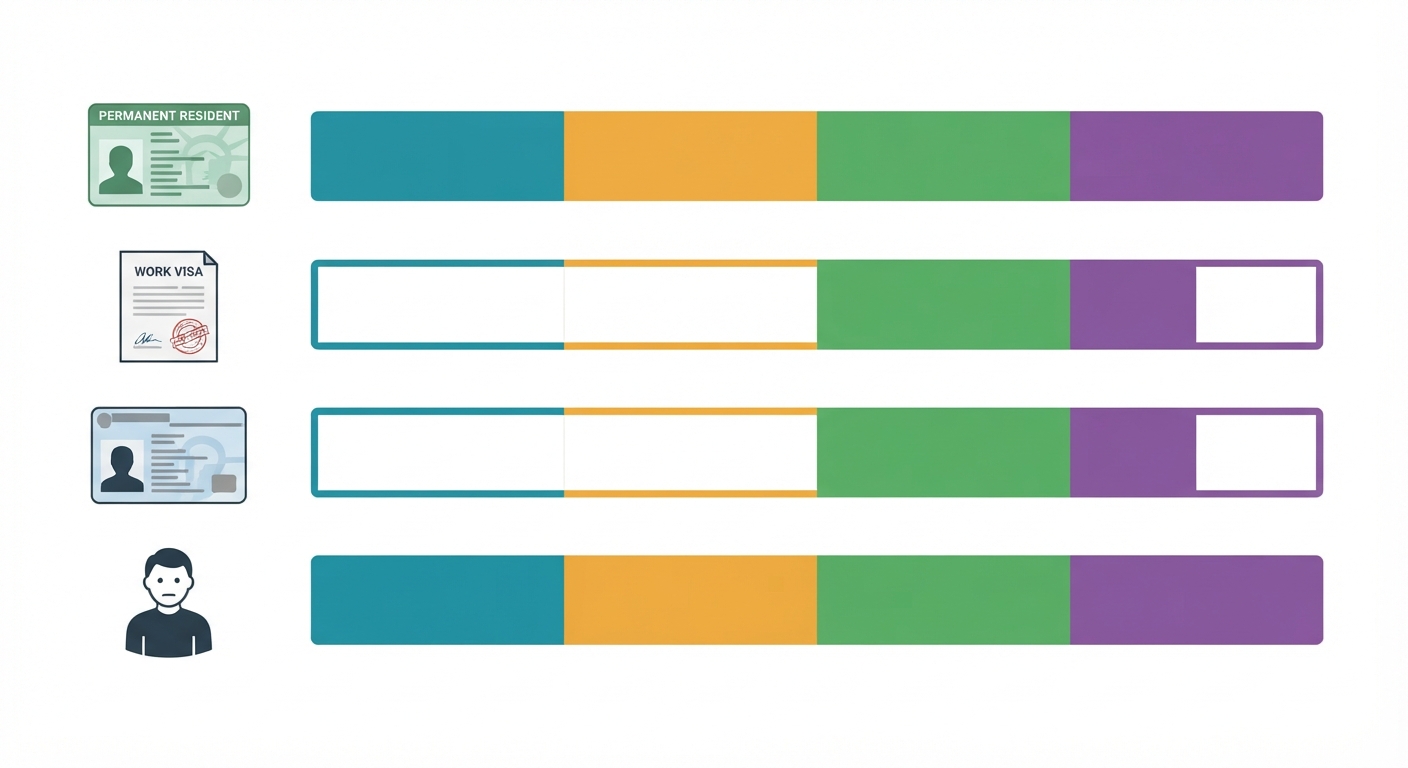
What this image shows: A four-row comparison of side-income possibilities by immigration status. Green card holders have broadly available options across active work, freelancing, business ownership, and passive income. Work visa holders have significant restrictions on active income and additional employment, while passive investment income may generally remain available. EAD holders generally have broader employment flexibility. Undocumented immigrants face significant restrictions on employment, with some forms of investment or business activity requiring separate legal and tax analysis. The visual reinforces the idea that immigration status can determine your side-income options.
Green Card Holders (Lawful Permanent Residents)
Green card holders generally have the broadest range of work and income options among immigrants in the United States.
You can generally work for different employers, operate a business, perform freelance work, participate in gig platforms, and earn income from investments. Your employment authorization is not normally tied to one sponsoring employer or a particular job.
That gives lawful permanent residents a level of financial flexibility that is much closer to that of U.S. citizens.
There are still exceptions and restrictions in certain areas, particularly some federal government positions and jobs requiring specific citizenship qualifications. But for most private-sector employment, business ownership, freelancing, and investment activities, green card holders have substantial flexibility.
Work Visa Holders (H-1B, L-1, TN, O-1, and Others)
For many work visa holders, employment authorization is connected to the specific employer, position, or petition that supports the visa.
That distinction is critical when considering a side hustle.
Gig platform work (DoorDash, Uber Eats, Amazon Flex, Instacart, Lyft): In many cases, this is not permitted without appropriate employment authorization. These platforms generally involve performing services for compensation as an independent contractor. For someone whose employment authorization is restricted to a particular sponsoring employer, that additional work can create a serious immigration issue.
Freelancing for clients: Freelancing is generally not automatically permitted simply because you are performing the work from home or receiving payment through an online platform. Depending on your visa category and circumstances, additional authorization may be required.
Running an active business: Owning a company and actively working for that company are not necessarily the same thing. Someone on an H-1B or similar status should not assume that forming an LLC automatically gives them permission to work in that business.
Passive income: This is where things become different. Income from investments, interest, dividends, certain rental activities, and some royalties may generally be treated differently from employment because you are not providing ongoing labor to an employer or client.
The single-employer exception: Some H-1B workers have concurrent H-1B employment authorized through petitions from more than one employer. If you have this type of arrangement, the permitted work must remain within the scope of the approved employment. Confirm the details with an immigration attorney.
If you hold a work visa and are considering any type of side income, do not rely solely on general advice found online. If you are uncertain, speak with a qualified immigration attorney before beginning the activity.
The potential consequences of unauthorized employment can be serious.
EAD Holders (Employment Authorization Document)
An Employment Authorization Document, commonly called an EAD or work permit, can provide much broader employment flexibility depending on the category under which it was issued.
EAD holders can include people with pending adjustment-of-status applications, certain TPS beneficiaries, eligible asylum applicants, and individuals in other immigration categories that provide employment authorization.
With a valid EAD, you can generally:
- Work for an employer.
- Perform qualifying gig-platform work.
- Freelance for clients.
- Operate a business, subject to applicable laws.
- Earn income from other lawful employment activities.
The important limitation is that your work authorization must remain valid.
If your EAD expires and you do not have another basis for employment authorization, continuing to work can create an unauthorized-employment problem.
For this reason, do not wait until the last minute to think about renewal. Check your expiration date carefully and follow current USCIS rules regarding renewal eligibility and timing.
DACA Recipients
DACA provides deferred action from removal and, for eligible recipients, employment authorization through an EAD.
With a valid DACA EAD, you can generally work for employers and participate in employment activities covered by your work authorization.
However, individual gig platforms may have their own requirements for documentation and account verification. Always confirm the platform’s current requirements before signing up.
DACA and self-employment can also involve additional legal considerations. Operating as an independent contractor and formally owning and operating a business are not necessarily identical from an immigration-law perspective.
If you are considering substantial self-employment or business activity, consult an immigration attorney who understands your specific situation.
Undocumented Immigrants Without Work Authorization
If you do not have employment authorization, you are not legally authorized to work in the United States.
Major gig platforms generally require documentation such as a Social Security number and verification of work authorization before allowing workers to participate.
Providing false information about your immigration or employment authorization can create additional legal problems.
Some financial activities are different from employment. For example, investing your own money can generate passive investment income, and business formation is governed in part by state law. However, forming a business does not automatically mean that you are authorized to personally perform work for that business.
Tax rules, immigration rules, and state business laws can overlap in complicated ways.
If you are undocumented, do not assume that an activity is legal simply because another undocumented person is doing it. Get qualified legal advice before engaging in work or business activity.
Passive Income: An Option Available to Many Immigrants
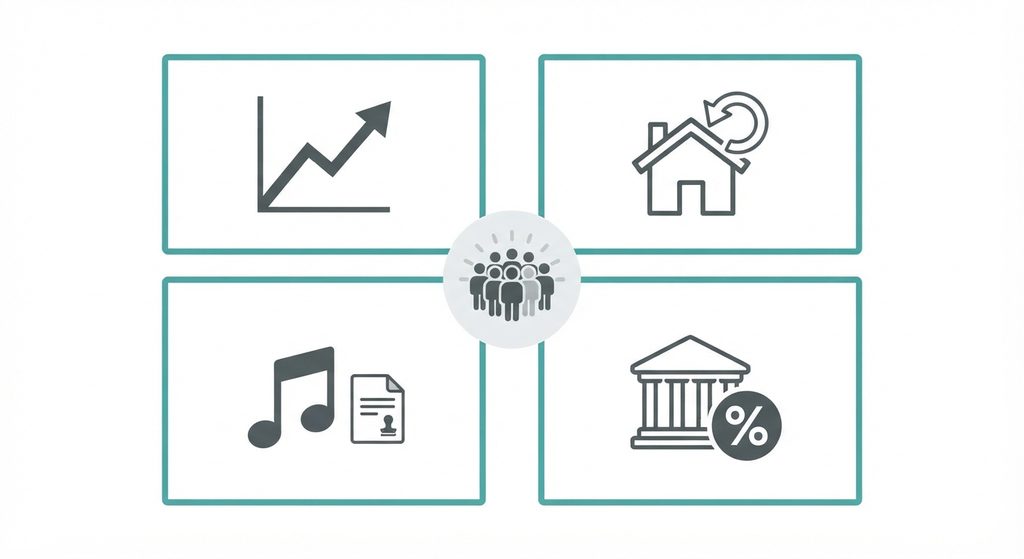
What this image shows: Four forms of passive income that can generally be different from employment: investment dividends and distributions, rental income from property ownership, royalties from intellectual property, and interest from savings accounts or bonds. Because passive income does not necessarily involve providing ongoing services to an employer or client, it can be treated differently from active employment. However, individual immigration circumstances can affect the analysis.
Passive income is fundamentally different from earning money by performing ongoing services for an employer or client.
That distinction can make investment income particularly interesting for immigrants whose immigration status limits additional employment.
Dividends and Investment Income
Lawfully investing in the U.S. stock market is generally available to many immigrants, including people holding work visas.
Investments such as stocks, ETFs, and index funds can produce dividends, distributions, and capital gains. These are investment returns rather than wages from employment.
If you are eligible to open a brokerage account, you can begin investing according to your financial situation and applicable tax rules.
Our guide on what is investing and why does it matter explains the basics for someone starting from zero.
Rental Income
Owning property and renting it to tenants can produce rental income that is generally treated differently from wages earned through employment.
Green card holders, work visa holders, and many other immigrants can own property in the United States, subject to applicable laws and their individual circumstances.
However, there is an important distinction between passively owning rental property and actively operating a property-management business.
If you are managing multiple properties as an active business or providing substantial services, the immigration analysis can become more complicated.
Interest Income
A high-yield savings account can generate interest without requiring you to work for an employer or client.
The same principle applies to interest generated by qualifying bonds and other investments.
There is no delivery route, client meeting, or work shift involved.
Royalties
Royalties can sometimes provide another source of income for creators.
If you created intellectual property—such as writing, music, photography, designs, or other creative work—income from licensing that property may be treated differently from active employment.
However, the distinction between passive royalties and active work is not always straightforward.
For example, regularly creating new work for clients in exchange for payment is very different from receiving continuing royalties from previously created intellectual property.
If you are relying on royalties as a side-income strategy while on a restricted immigration status, get professional legal advice about your specific situation.
Fractional Real Estate Platforms
Some investment platforms allow individuals to purchase fractional interests in real estate rather than buying an entire property themselves.
Platforms such as Arrived and Fundrise are examples of services that provide access to certain real-estate investments.
Because investors can participate without personally managing tenants or operating the property, this can potentially provide a more passive form of real-estate exposure.
Our article on become a landlord with $100 explains how fractional real-estate investing works.
Side Hustles for EAD Holders and Green Card Holders
If your immigration status gives you authorization to engage in additional employment, you have considerably more options.
Below are some of the most accessible ways immigrants can potentially generate additional income.
Gig Delivery and Rideshare
As explained in our detailed article on delivery jobs explained, major platforms such as DoorDash, Uber Eats, Amazon Flex, Instacart, and Lyft can provide flexible earning opportunities for workers who meet the platforms’ documentation and work-authorization requirements.
For EAD holders and green card holders, gig work can be one of the quickest ways to turn available time into additional income.
But do not confuse gross earnings with actual profit.
Fuel, vehicle maintenance, depreciation, insurance, platform expenses, and taxes all reduce what you actually keep.
After accounting for vehicle expenses and setting aside money for self-employment taxes, effective hourly earnings may be considerably lower than the amount displayed in the app.
Peak periods, especially lunch, dinner, weekends, and busy local events—can generally produce better earning opportunities than slower periods.
Freelancing Your Professional Skills
If you have professional skills from your current career, previous career, education, or experience in your home country, freelancing can potentially produce significantly more income per hour than delivery work.
Popular freelance marketplaces include Upwork and Fiverr for a broad range of services, Toptal for highly skilled technology and finance professionals, Contra for creative and marketing work, and Guru for technical and business services.
Skills that can have strong demand include:
- Software development
- Data analysis
- Graphic design
- Translation and interpretation
- Writing and editing
- Digital marketing
- Accounting and bookkeeping
For immigrants whose credentials from their home country have not yet been recognized in the United States, freelance work can also help demonstrate practical skills and build a portfolio of U.S.-based work.
That experience can become useful when pursuing future employment or professional credential recognition.
Tutoring and Teaching
If you have expertise in a subject, tutoring can be another flexible way to generate additional income.
Platforms such as Wyzant, Tutor.com, Chegg Tutors, and Preply connect tutors with students.
Language tutoring can be particularly attractive for immigrants.
If English is your second language and you are fluent in a language that American students want to learn—including Spanish, Mandarin, French, Arabic, and many others—you may have a skill that can be monetized without requiring a traditional second job.
Tutoring rates can vary substantially depending on the subject, level, location, platform, and your experience. Established platforms may offer rates ranging from approximately $20 to $80 per hour, while independent tutoring through schools, community organizations, or referrals may offer different rates.
Selling Products
Selling products can provide another potential source of income for people who have the necessary work authorization.
Products can include physical goods such as crafts, permitted homemade foods, imported products, vintage items, or culturally specific merchandise.
Digital products can include templates, printables, stock photography, digital artwork, educational materials, and other downloadable products.
Platforms such as Etsy, eBay, Mercari, and Amazon FBA provide different ways to reach customers.
For immigrants who have access to culturally distinctive products, handmade goods, or products connected to their home countries, this can be a particularly interesting niche.
However, remember that operating a business creates tax and regulatory responsibilities.
Business income can be treated as self-employment income, and you may have federal, state, and local obligations depending on what you sell and where you operate.
TaskRabbit and Skilled Services
For immigrants with practical skills, local service marketplaces can provide another way to earn money.
TaskRabbit connects customers with people who provide services such as furniture assembly, moving assistance, cleaning, handyman services, yard work, and general labor.
For workers who have valid employment authorization and meet the platform’s requirements, these services can be appealing because they allow practical skills to generate income without necessarily requiring formal U.S. credentials.
Rates vary significantly by task and market, but many urban markets can offer opportunities in the range of approximately $25 to $75 per hour for certain services.
The Tax Reality of Any Side Income
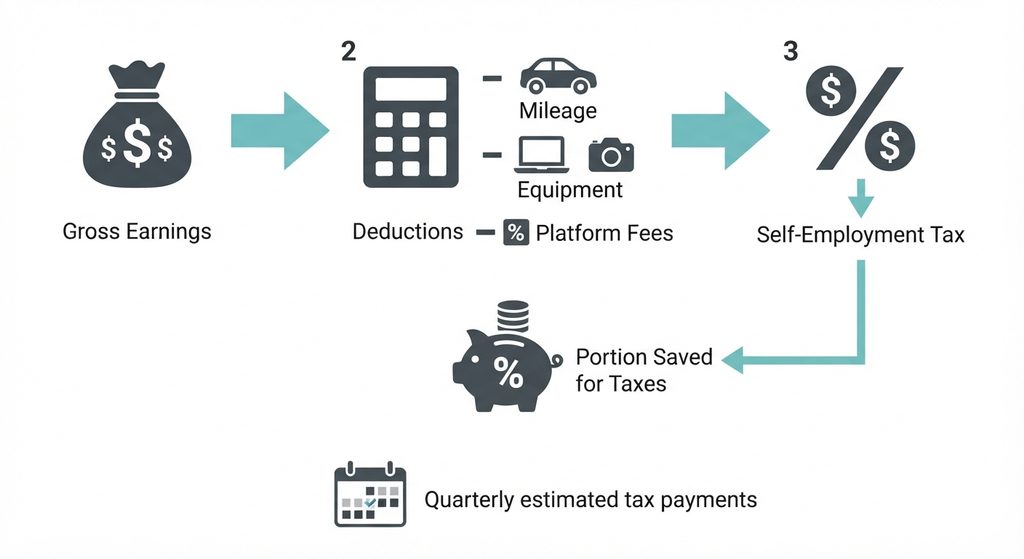
What this image shows: A three-stage overview of how taxes can work with gig and freelance income. Begin with gross earnings, subtract eligible business expenses, and then account for self-employment and income taxes. The visual also emphasizes setting money aside throughout the year and considering estimated tax payments when required.
No matter which side-income strategy you choose, there is one part that catches many new gig workers off guard:
Taxes.
When you work as an independent contractor or operate as a self-employed individual, you may be responsible for both the employer and employee portions of Social Security and Medicare taxes through the self-employment tax.
The self-employment tax rate is generally 15.3% on the applicable net earnings, before considering the effect of income-tax deductions and other rules.
This is separate from your regular federal and potentially state income tax.
For example, on $10,000 of qualifying net self-employment income, the self-employment tax itself would be approximately $1,413 after the standard adjustment used in the self-employment-tax calculation, before considering regular income tax.
That is why setting aside part of your side income from the beginning is so important.
A practical approach is to automatically move approximately 25% to 30% of your side-income deposits into a separate savings account until you know your actual tax liability.
If you expect to owe enough tax to require estimated payments, you may need to make quarterly estimated tax payments during the year.
Missing required estimated payments can result in penalties.
You can also generally deduct qualifying business expenses before determining taxable business income.
Depending on your activity, these may include:
- Business mileage
- Equipment purchased for the business
- Platform fees and commissions
- Certain phone expenses
- Other ordinary and necessary business expenses
For example, gig workers who drive for business purposes may be able to use the IRS standard mileage rate if they meet the applicable requirements and maintain proper records.
The key is documentation.
If you claim mileage, keep mileage records. If you purchase equipment, keep receipts. If you pay platform fees, retain the relevant statements.
Good records can make a major difference when tax time arrives.
For free help with self-employment taxes as an immigrant filer, our article on free tax filing resources every newcomer should know about covers VITA locations and other free tax-preparation resources that may be available.
Getting Started: The Practical Steps
Once you have confirmed that your immigration status allows the activity you want to pursue, follow a simple process.
Step 1: Confirm That Your Status Allows the Activity
This should always come first.
If you are unsure whether a side hustle constitutes authorized employment, talk to a qualified immigration attorney before you begin.
Do not base your decision solely on what a coworker, friend, influencer, or online forum says.
Two people can perform exactly the same type of work while having completely different immigration restrictions.
Step 2: Gather the Required Identification and Authorization Documents
Gig platforms commonly require documentation such as an SSN, government-issued identification, and evidence of work authorization.
Depending on your immigration status, this may include a green card or EAD.
Freelancing platforms and payment providers can have their own verification requirements.
Make sure the information you provide is accurate.
Step 3: Separate Your Side-Income Money
Consider opening a separate bank account for your side income.
This does not necessarily mean you need a complicated business banking structure.
The goal is simply to make it easier to distinguish your side-income deposits from your regular household spending.
A separate account can make tracking income, expenses, and tax savings much easier.
Step 4: Start Tracking Mileage Immediately
If your side hustle involves driving, start tracking mileage from day one.
Apps such as MileIQ, Everlance, and Stride can help record business mileage and organize records.
Mileage can be one of the most valuable deductions available to eligible gig workers, but you need reliable records to support the deduction.
Step 5: Create Your Tax Reserve Immediately
Do not wait until tax season to think about taxes.
Set aside approximately 25% to 30% of your side-income deposits in a separate savings account until you have a clearer picture of your actual tax obligation.
Automating the transfer can make this much easier.
The important idea is simple:
Save for taxes before you spend the money.
Step 6: Track Every Business Expense
Keep records of legitimate expenses as they happen rather than trying to reconstruct everything months later.
A spreadsheet can be enough.
You can also use accounting or expense-tracking tools such as Stride or Wave.
Good records help you identify how much your side hustle actually earns after expenses—and can make tax preparation considerably easier.
The Bigger Financial Picture
Side income becomes much more powerful when you give every extra dollar a purpose.
Instead of simply allowing your lifestyle to expand, decide what the additional money is supposed to accomplish.
For example, your side income could be directed toward:
- Building an emergency fund
- Paying down credit-card debt
- Contributing to a Roth IRA
- Saving for a home down payment
- Increasing 401(k) contributions
- Building a business fund
- Creating a financial cushion for your family
The goal is not necessarily to work more forever.
The goal is to use additional income strategically.
If you decide what the money is for before you earn it, you are much more likely to turn side income into actual financial progress.
Otherwise, extra money has a habit of disappearing into higher spending, larger subscriptions, more meals out, and lifestyle upgrades.
For a broader look at how immigrants can increase income and build financial stability over time, our article on how to make enough money to survive here explores strategies ranging from immediate income opportunities to longer-term career development.
Disclaimer: This article is provided for educational and informational purposes only and does not constitute legal, immigration, tax, or financial advice. Immigration and employment-authorization rules are complex and can change over time. The discussion of immigration statuses and income activities is general in nature, and individual circumstances can produce different results. If you are on an employer-sponsored visa, have an uncertain immigration status, or are unsure whether a particular activity constitutes authorized employment, consult a qualified immigration attorney before beginning the activity.